
How to Get on the First Page of Google: A Plan for New Websites
You publish a page, wait a month, and still see nothing. Then you read another list of “SEO tricks” that promise page one by Friday. Here is the honest answer. Nobody can guarantee a first-page spot. But if you want to know how to get on the first page of Google, the path is clear. Choose a keyword you can actually win. Match what searchers want. Make a page more useful than the ones already ranking. Get it indexed. Then measure what happens.
The odds are worth knowing. Ahrefs found that only a small share of new pages reach the top 10 within a year, and that pages aimed at low-volume keywords get there faster. So a new site should start small and specific, then build. Many people type “how can I get my website on Google first page” and hope for a trick. There isn’t one, but there is an order of work. Below you will find nine steps, a worked example from Pordix’s own plan, a 30-day schedule and a short look at where speed fits.
How Google Decides Who Gets on the First Page
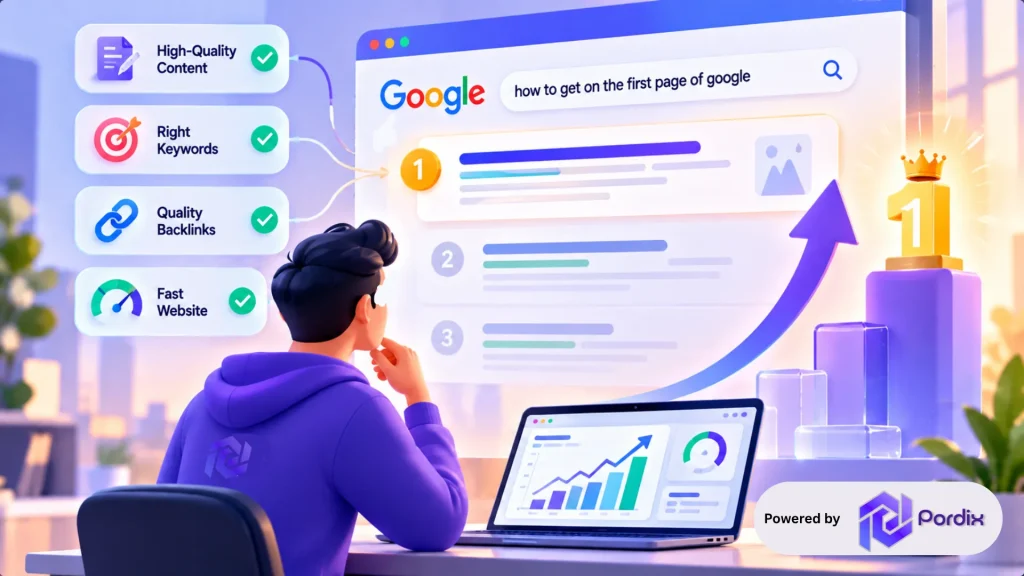
Google shows the pages that fit each search best. Three things decide that when you work out how to get on the first page of Google.
- Intent. Every search has a goal. Someone typing a how-to phrase wants steps. Someone typing a product name may want to buy. If your page gives the wrong kind of answer, it struggles, however well it is written.
- Usefulness. Google rewards pages that cover a topic clearly and with real detail. Its guidance on helpful, people-first content explains what that means. For AI-written pages, see our article on how AI content ranks on Google.
- Trust and access. Google must be able to crawl and index your page, and the page has to feel trustworthy.
Google also frames quality as E-E-A-T: experience, expertise, authoritativeness and trust. A page that shows first-hand knowledge, names its author and cites sources beats one that repeats what everyone else says. That holds for AI-assisted writing too. Google’s guidance on AI-generated content says it looks at quality, not at how content is made.
New sites feel competition most. Established sites have years of links behind them. So how to get on first page of Google for a crowded search is often a choosing problem, not a content problem. Aim narrow. Google’s SEO Starter Guide frames the job as making your site easier to crawl, index and understand. It promises no ranking, and neither should you.
How to Get on the First Page of Google: 9 Practical Steps
Work through these in order. Skipping the early steps is the most common reason good pages go nowhere.
1. Pick a keyword you can realistically win
Choose specific searches, not the biggest ones. Compare volume and difficulty in Google Keyword Planner, Search Console or a tool like Semrush. Treat difficulty scores as a guide, not a promise. A few hundred monthly searches you can win beat thousands you never will. That is how most new sites learn how to get on first page of Google: they start small and stack wins. Do smaller sites already rank? Is the intent clear? Can you add first-hand detail? If any answer is no, pick another keyword.
2. Read page one before you write
Open the top results. Note their format, length, shared subheadings and the questions they answer. Then note what they miss. That gap is your brief. Google’s results page also shows related questions for many searches, which are free clues about what readers want next. If most results are step-by-step guides, a sales page will not compete. If you cannot say what your page will add, do not write it yet. Learning how to be on the first page of Google starts with studying who is already there.
3. Write something more useful than what is there
Do not rewrite what ranks. Add what it lacks: your own examples, screenshots, numbers and mistakes. A page about site speed, for instance, is far more convincing with your own before-and-after test than with generic advice. Answer the question in the first paragraph, in short sentences and plain words. This is where E-E-A-T gets practical. Name the author, say what you tried and cite trusted sources. Run your draft against Google’s people-first content checklist before you publish. That is the quiet core of how to get on the first page of Google: be the most useful answer.
4. Get the on-page basics right
Use your keyword naturally in the title, H1 and URL. Keep the title under about 60 characters, use one H1, and write subheadings that describe what follows. Add a meta description that earns the click, and alt text on images. Put the answer near the top. On WordPress, an SEO plugin handles much of this. Our guide to the best SEO plugin for WordPress explains what plugins do and do not do.
5. Make sure Google can find and index the page
A page that is not indexed cannot rank. Set up Google Search Console, submit your XML sitemap and check the page with the URL Inspection tool. If it is missing, look for a noindex tag, a robots.txt block, or a page nothing links to. Fix the cause, then request indexing again. If Google has crawled the page but not indexed it, the page usually needs more value. Indexing can take days or weeks for a new site. If you are still choosing a platform, see our guide to the best CMS for SEO. Google’s Search Central documentation covers each issue in detail.
6. Link your pages together
Internal links help Google find pages and understand how they relate. Link each new page to related ones, and link back to it from older pages. Use descriptive anchor text, not “click here”. Our WordPress performance plugin comparison sends readers to our Core Web Vitals guide for deeper fixes. Each page does its own job, then hands the reader off. Watch for orphan pages, which are pages with no internal links pointing to them. Over time, this builds a topic cluster, which is how to get on page 1 of Google with a small site.
7. Earn links and mentions honestly
Links from trusted, relevant sites tell Google your page is useful. Publish something worth citing, like original data, a free tool or a practical guide, then share it with people who care about the topic. Expert comments in articles from your field and listings in respected industry directories help too. Do not buy links. Google’s spam policies list buying or selling links for ranking as link spam. Paid placements are fine for advertising if they carry a rel=”nofollow” or rel=”sponsored” attribute.
8. Fix speed and mobile problems
Google mostly uses the mobile version of a page when it indexes it. Most guides on how to be on the first page of Google list this step, and for good reason. Run PageSpeed Insights, then test on a real phone. Make sure the mobile page has the same main content as the desktop one, and avoid pop-ups that cover the text. We cover speed in more detail below.
9. Measure, then update
Open the Performance report in Search Console and watch impressions, clicks and average position over several weeks. The report defaults to the past three months, and results vary by place and device. Average position is an average across many searches, so ignore one-day swings. Pages at positions 11 to 20 are your best targets. If you wonder how to get on page 1 of Google from page two, start there. Add missing sections, update old facts and add internal links.
Mistakes that keep new sites off page one
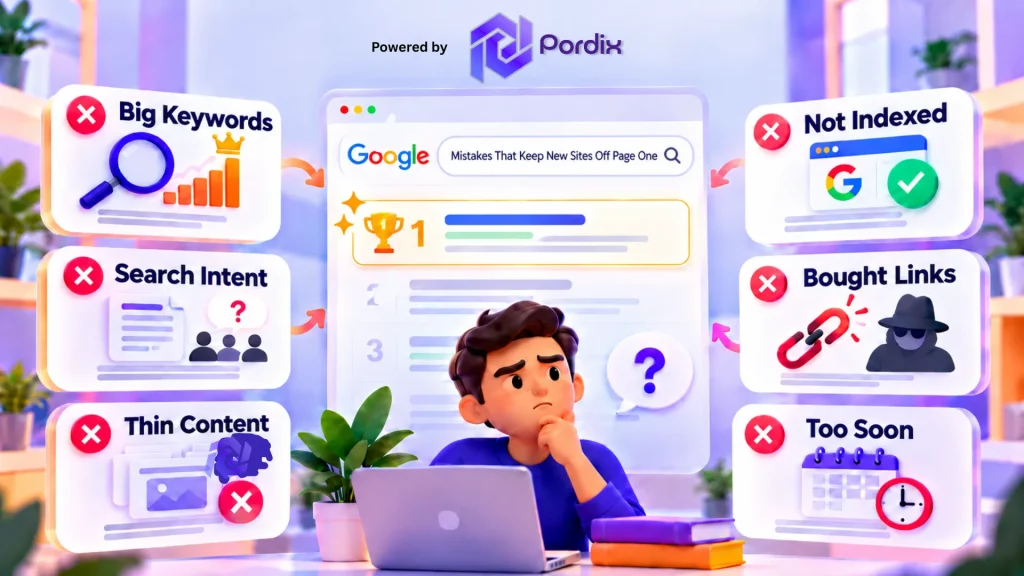
- Chasing keywords far too big for a new site.
- Writing before checking what searchers expect.
- Publishing thin pages to add content.
- Forgetting to check that Google has indexed the page.
- Using shortcuts, such as bought links, that break Google’s rules.
- Judging results after two weeks, then changing everything.
Most of these come down to skipping steps 1, 2 and 5.
A Worked Example: How a New Website Picks a Keyword and Tracks Progress
Here is how to get on first page of Google in practice, using Pordix’s own plan. For its FastMe product, Pordix could have chased a broad search about speeding up WordPress sites, with volume in the thousands. Instead, it started with a narrower one: “wordpress performance plugin”.That search had about 170 monthly searches and a keyword difficulty of 17 in Semrush. Small, but winnable. It matched the product, and searchers were clearly comparing options. So the broader topic waited for a later article.
Before writing, the team read what ranked. It was mostly plugin roundups. So the article compares plugins by what each one fixes, says where each falls short, and discloses that FastMe comes from Pordix. That openness is part of what makes a page trustworthy. You can read it in our WordPress performance plugin comparison. In Search Console, Pordix tracks four things:
- Is the page indexed?
- Is it getting impressions for the target keyword?
- Is its average position moving?
- Which unplanned searches bring it up?
The article went live in October 2026, so it is too early to report rankings. That is normal. Impressions come before clicks, and position moves slowly. For anyone wondering how to get on page 1 of Google, early impressions are the first sign you are on track. It also answers “how can I get my website on Google’s first page”: start where you can win, and track the right numbers while you wait.
A 30-Day SEO Action Plan for New Websites
This plan will not put you on page one in 30 days. It puts the work in the right order, which is what most guides on how to get on the first page of Google leave out.
| Week | Focus | What to do |
|---|---|---|
| 1 | Research | Pick one winnable keyword. Read the top results. List what they cover and what they miss. Set up Google Search Console. |
| 2 | Create | Write and publish one strong page. Get the title, headings, URL and meta description right. |
| 3 | Connect and index | Submit your sitemap and check indexing. Add internal links. Fix mobile and speed problems. |
| 4 | Earn and review | Share the page and ask relevant sites for a mention. Check Search Console and note what to improve. |
A good month looks like this: your page is indexed, it is collecting impressions, three or more pages link to it, and you have a list of improvements. Clicks may still be low. That is normal. Then repeat the loop with the next keyword. In truth, how to get on first page of Google for a new site is mostly this loop, repeated.
Where Website Speed Fits In
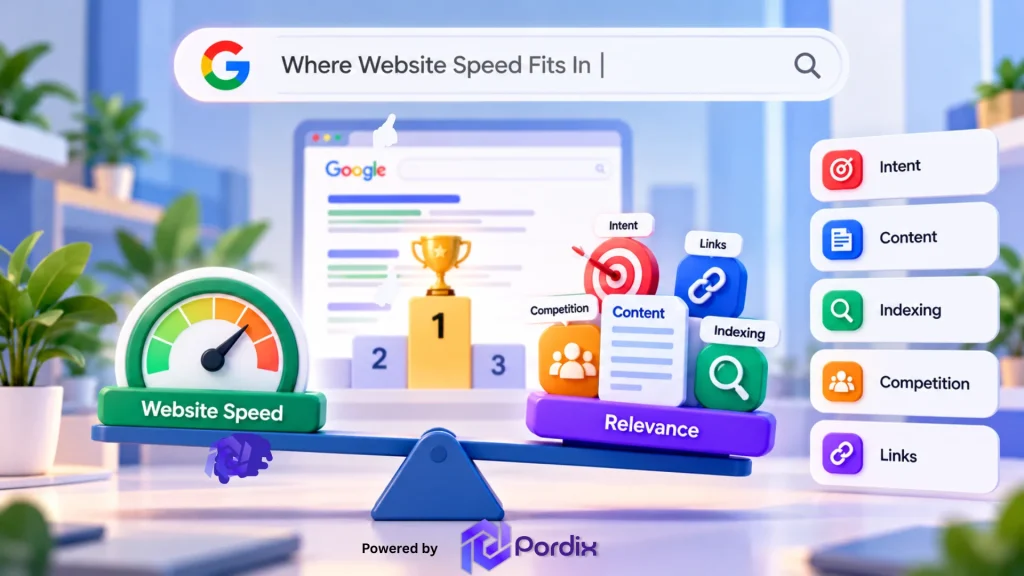
Speed supports SEO. It does not guarantee page one. Google’s Core Web Vitals measure loading, responsiveness and visual stability, and they are part of page experience. But relevance comes first. A fast page with a weak answer loses to a slower page with a better one. Think of speed as a tiebreaker, not a trump card.
Anyone asking how to be on the first page of Google will see speed in every checklist. Our guide on how to improve Core Web Vitals in WordPress covers the fixes, and performance-driven SEO and ROI covers the business side. Online stores can also read how site speed affects SEO and shopping behavior. If your site is fast and still does not rank, check these first:
- Intent: your page answers a different question from the ones ranking.
- Content: it is thin, copied or no better than what exists.
- Indexing: Google has not indexed it.
- Competition: the search is too crowded, so pick a narrower one.
- Links: nothing points to the page.
Fix the first item on that list that applies, then recheck in a few weeks. If speed really is a problem on your WordPress site, a tool can help. FastMe, built by Pordix, handles cache controls, image and WebP optimization, fonts, CSS and JavaScript, and keeps reports and logs so you can see what changed. It is a supporting piece, not a ranking shortcut, and results vary by theme, hosting and plugins. Compare it with other options in our WordPress performance plugin comparison, or visit the FastMe page.
Conclusion
There is no secret to how to get on the first page of Google, and no shortcut that lasts. There is a repeatable process: pick a search you can win, read what ranks, write something more useful, get it indexed, link your pages, earn links honestly and measure. For a new website, focus is the biggest advantage. Anyone serious about how to be on the first page of Google should treat it as a habit, not a one-off task. Aim at specific searches and build one strong page at a time. It is slower than a trick, but it lasts longer.
Be realistic about time. Indexing can take days, and rankings often take months. If you are asking how you can get your website on Google’s first page, start this week with step one and the 30-day plan. If you only do three things, pick one winnable search, publish one clearly better page and check that it is indexed.
Keep speed in its place. If your WordPress site needs help there, FastMe is one tool to look at.
Frequently Asked Questions
Q1. How long does it take to get on the first page of Google?
There is no fixed time. Ahrefs’ study of new pages found that most do not reach the top 10 within a year, and that low-volume keywords rank sooner than high-volume ones. So new sites often wait several months, and competitive searches take longer. Watch impressions and average position in Search Console to see progress before clicks arrive.
Q2. How can I get my website on Google first page without ads?
Do the organic work. Pick a winnable keyword, publish a page that is more useful than the current results, get it indexed, and build links over time. Ads can put you at the top quickly, but they stop when your budget does. Organic results take longer and last longer.
Q3. How to get on Google search first page with a new website?
Target specific searches rather than broad ones, and write pages that answer them better than the pages ranking now. Set up Search Console, confirm indexing, add internal links and earn a few relevant mentions. Then track results and improve.
Q4. How to get on page 1 of Google when competitors are bigger?
Narrow your searches. Choose phrases that bigger sites ignore, such as a specific audience, location or problem. Add detail they lack, like first-hand examples. Build a cluster of related pages so your site becomes a better answer on that topic.
Q5. Can anyone guarantee a first-page spot on Google?
No. Rankings depend on many factors that nobody controls, including competitors and Google’s own changes. Be careful with any agency or tool that promises a guaranteed position. Good SEO improves your chances. It cannot promise an outcome.