
Performance-Driven SEO ROI: How Site Speed Drives Rankings & Revenue
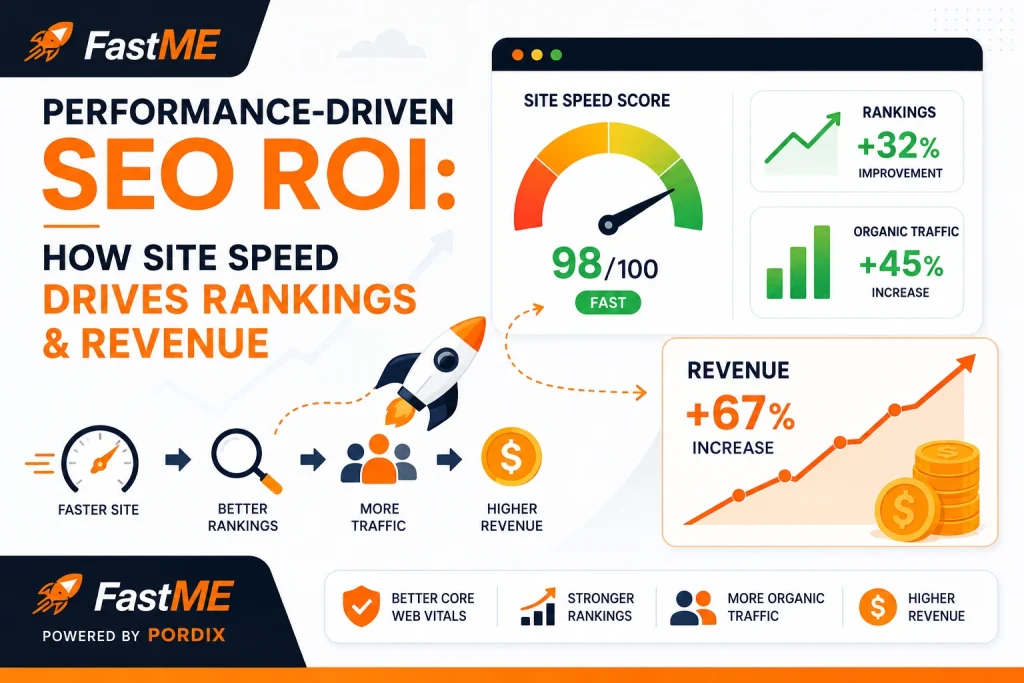
Site speed is not just a tech detail. It is one of the biggest growth levers on your website. A fast site earns trust in seconds. It keeps visitors on the page instead of losing them to the back button. It can rank higher in search results and turn more browsers into buyers. That full chain, from a fast load time to a real sale, is what we call performance-driven SEO ROI.
Performance-driven SEO ROI is the return you get when a faster site improves your rankings, your traffic, and your sales, all at the same time. Speed up your site, and you don’t just please Google. You give every visitor a smoother path to checkout, to a form fill, or to a phone call. That means more revenue from the same traffic you already have.
This guide breaks the idea into three clear parts: rankings, conversions, and fixes. You will also get a short checklist you can run today to find where your own site is losing time, traffic, and money to slow pages. And a no-code optimization plugin that helps in to boost the website performance a.k.a FastMe: powered by Pordix
What Is Performance-Driven SEO ROI?
Most SEO reports track rankings and clicks. Most speed reports track load time. This idea joins the two. It asks one clear question: how much more revenue do we gain when the site gets faster?
Here is why that link matters. Google looks at page experience when it ranks sites. A faster page can rank higher. A higher rank brings more visitors. Those visitors, on a smooth site, are more likely to buy or sign up. Speed leads to rank. Rank leads to traffic. Traffic leads to revenue.
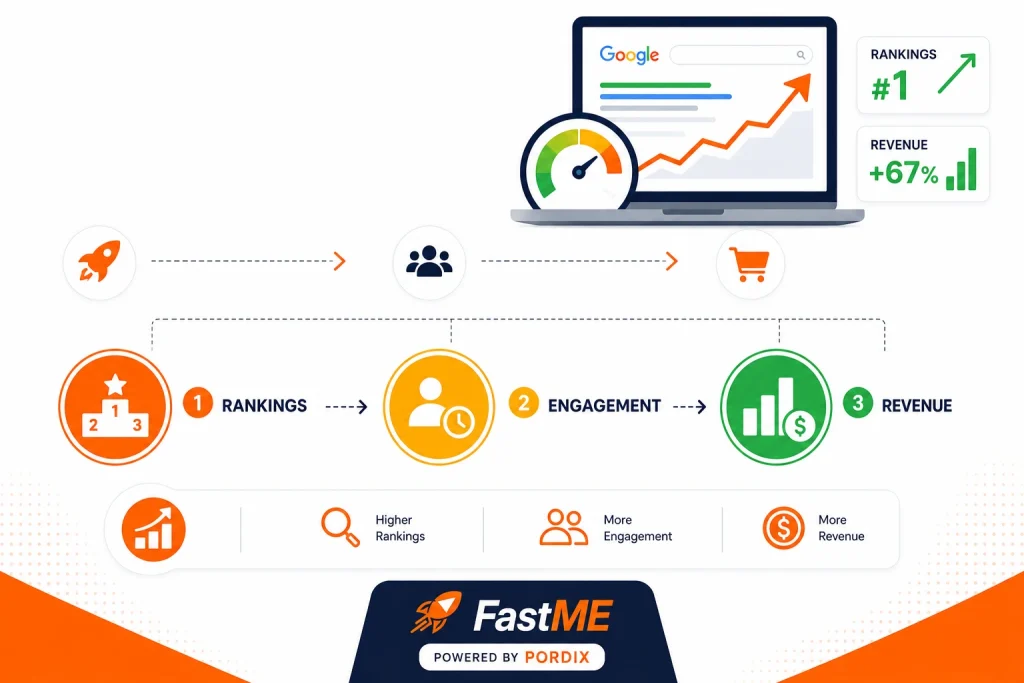
Three parts make up this model:
- Rankings — how speed affects your spot in search results
- Engagement — how speed affects bounce rate and time on page
- Revenue — how speed affects sales, leads, and form fills
Track all three at once. That gives you the full ROI picture.
How Page Speed Affects SEO Rankings
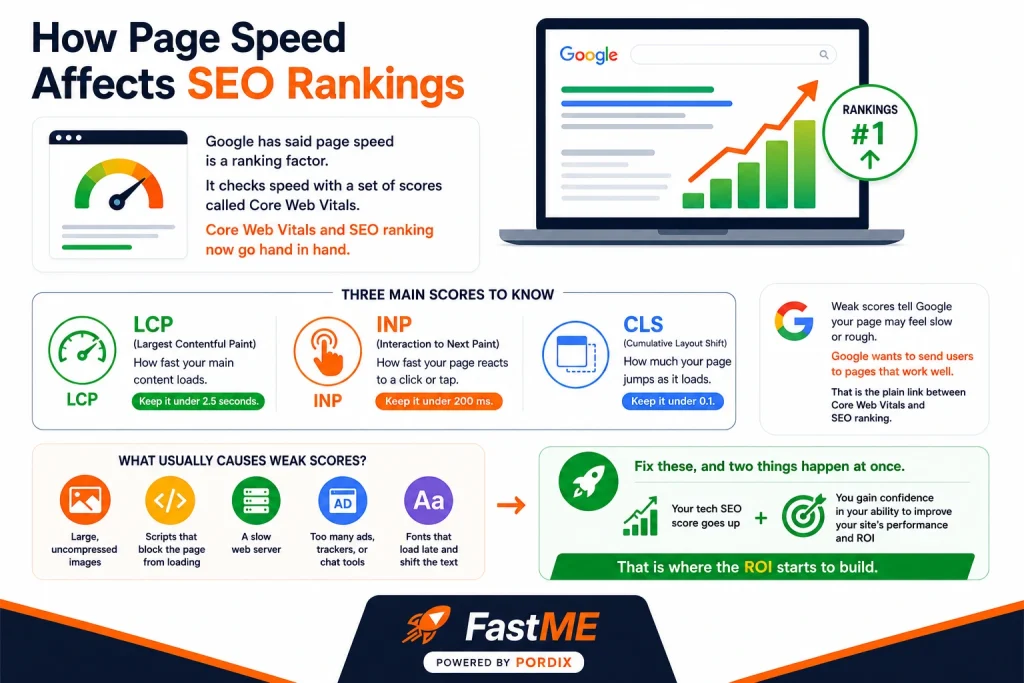
Google has said page speed is a ranking factor. It checks speed with a set of scores called Core Web Vitals. Core Web Vitals and SEO ranking now go hand in hand.
There are three main scores to know:
- LCP (Largest Contentful Paint) — how fast your main content loads. Keep it under 2.5 seconds.
- INP (Interaction to Next Paint) — how fast your page reacts to a click or tap. Keep it under 200 milliseconds.
- CLS (Cumulative Layout Shift) — how much your page jumps as it loads. Keep it under 0.1.
Weak scores tell Google your page may feel slow or rough. Google wants to send users to pages that work well. That is the plain link between Core Web Vitals and SEO ranking.
What usually causes weak scores?
A few common culprits:
- Large, uncompressed images
- Scripts that block the page from loading
- A slow web server
- Too many ads, trackers, or chat tools
- Fonts that load late and shift the text
Fix these, and two things happen at once. Your tech SEO score goes up. Your site also feels better to real users. That is where the ROI starts to build.
Website Speed and Conversion Rate — Where ROI Actually Shows Up
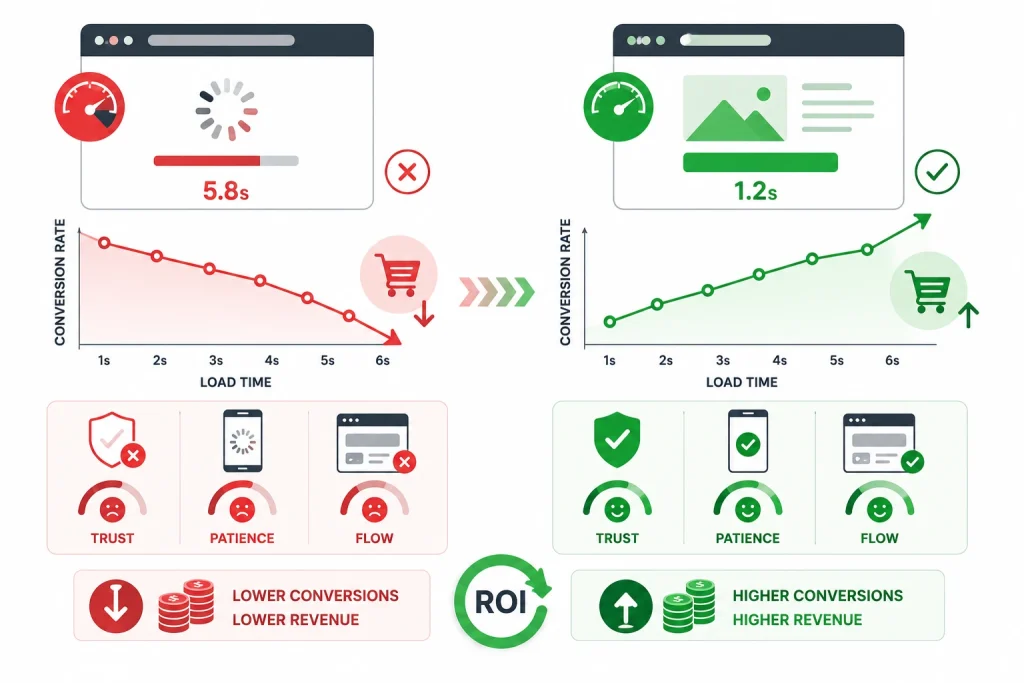
A high rank means little if no one buys. This is where website speed and conversion rate meet. Study after study shows the same trend. As load time goes up, sales go down. Even a one-second delay can cost you leads, sign-ups, and sales.
Why does speed hit sales so hard? A few plain reasons:
- Trust: A fast site feels safe and real. A slow one feels broken.
- Patience: Mobile users leave fast. Many will not wait for a slow page to load.
- Flow: A checkout or a lead form needs to feel smooth. Any lag can lose the sale right at the end.
This is the clearest proof of the link between speed and revenue. A fast site helps you get found. It also helps you get chosen once a visitor lands.
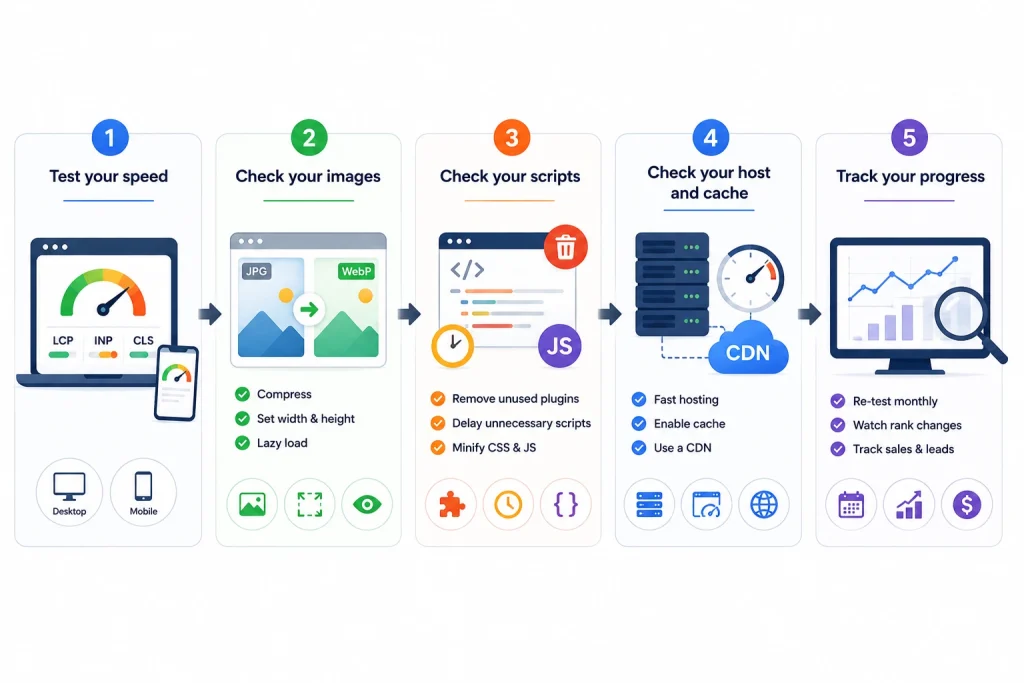
SEO Performance Audit Checklist — Find Your Speed Leaks
Use this list to find where your site loses rank, traffic, and sales to slow load times.
Step 1: Test your speed
- Run your home page and top pages through PageSpeed Insights
- Note your LCP, INP, and CLS scores on both mobile and desktop
Step 2: Check your images
- Compress images and switch to WebP files
- Set width and height on each image to stop layout shift
- Use lazy load for images below the fold
Step 3: Check your scripts
- Remove plugins you no longer use
- Delay scripts that are not needed right away
- Shrink your CSS and JS files
Step 4: Check your host and cache
- Make sure your host responds fast
- Turn on browser and page cache
- Add a CDN if you get traffic from more than one region
Step 5: Track your progress
- Re-test each month, not just once
- Watch how rank shifts as speed shifts
- Log any change in sales or leads after each fix
Run this checklist every few months. New plugins and new content can slow a site down again.
Fixing Slow Performance Without the Guesswork — How FastMe Helps
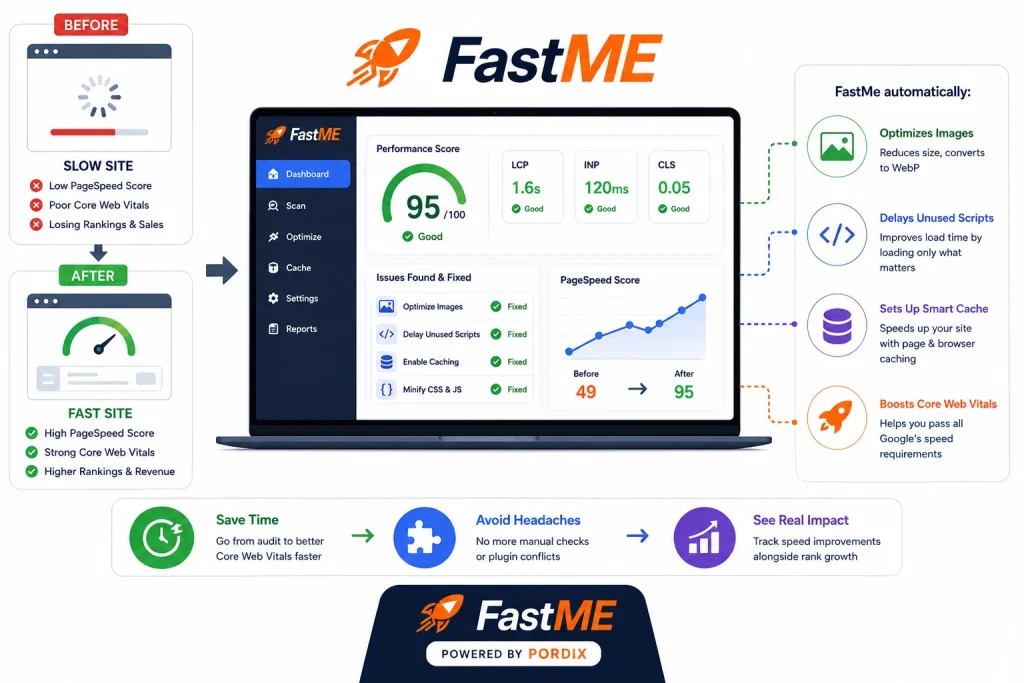
Not every site owner has time to check each image, script, and plugin by hand. This is where a tool like FastMe can help.
FastMe was built to help you improve PageSpeed score WordPress sites, with no code needed. It scans your site, finds the issues that slow you down, and fixes many of them for you, such as image size, script delay, and cache setup.
For any team that wants strong SEO ROI from performance, this saves real time:
- Faster path from audit to a better Core Web Vitals score
- Fewer hours spent hunting for plugin conflicts
- A clear view of speed change next to rank change
If your checklist above turned up more issues than you hoped, that is normal. Most WordPress sites build up speed debt over time. A tool like FastMe can clear that debt fast, so your gains show up sooner.
Final Thoughts
A fast site is not a small detail. It is a growth tool, working for you around the clock. Every second you shave off your load time pays you back twice: once in rank, and once in revenue.
Track three numbers side by side, every month: your rank, your Core Web Vitals and SEO ranking scores, and your sales. When one moves, watch the others. That is how you prove the ROI, not just guess at it.
Start with the checklist above. Fix what you can this week. Then try FastMe if you want the heavy lifting done for you, without the guesswork or the code. Speed is not just a tech win. It is one of the fastest, most direct paths to more traffic, more trust, and more revenue.
Frequently Asked Questions
1. What is performance-driven SEO ROI, and why does it matter for my business?
Performance-driven SEO ROI is the link between site speed and the money it earns you. It matters because Google uses speed to help rank pages. Faster pages also keep visitors around long enough to buy. If you only track rank, or only track speed, you miss half the story. Track both together, and you can see which fixes are worth your time.
2. How long does it take to see ranking gains after fixing site speed?
Core Web Vitals scores often improve within days. Speed tools like PageSpeed Insights update fast. Rank changes take longer, usually two to six weeks, since Google needs time to recrawl your pages. Conversion rate often improves the fastest of all. Real visitors feel the change right away, sometimes within the same week.
3. Do Core Web Vitals affect every page, or just my homepage?
Core Web Vitals get scored page by page, not site-wide. Your homepage, product pages, and blog posts can each score differently. A fast homepage does not mean a fast checkout page. Check your top pages one by one. Focus first on the pages that bring the most traffic and sales.
4. What is FastMe, and how does it help my WordPress site load faster?
FastMe, powered by Pordix, is a WordPress speed tool. It finds and fixes the issues slowing your site down, with no code needed. It compresses images, delays scripts you don’t need right away, and sets up caching for you. Then it shows a clear before-and-after view of your Core Web Vitals scores. It is built for site owners who want real speed gains without hiring a developer.
5. Who is Pordix, and why should I trust it for site performance?
Pordix is the team behind FastMe. Its focus is making technical SEO fixes simple for everyday WordPress users. Instead of another dashboard full of jargon, Pordix builds tools that make real fixes and show plain, clear results. If you want speed gains without the guesswork, that is the job Pordix built its tools to do.