
How AI Content Ranks on Google: What Actually Matters
AI has changed how businesses approach content creation. From blog articles and product pages to marketing materials, many teams now use AI tools to improve their writing workflows, reduce production time, and create content at scale. However, one question continues to create uncertainty: Does Google actually rank Ai content?
The answer is yes, but ranking is not determined by whether a piece of content was created by a human or assisted by AI. Google policies says that it focuses on the quality of the final result. Content must be helpful, accurate, original, and created with the user’s needs in mind. This is why some AI-assisted articles perform well in search results, while others struggle to gain visibility.
The difference comes down to how the content is created, reviewed, and improved. AI-generated content SEO is not about publishing automated text without review. It is about combining AI efficiency with human expertise, editorial judgment, reliable information, and a clear understanding of search intent.
In this article, we will explore how AI content ranks on Google, the key factors that influence its performance, and the process businesses can follow to create AI-assisted articles that provide genuine value for readers while remaining optimized for modern search experiences, including AI Overviews and generative search.
Can AI-Generated Content Really Rank on Google?
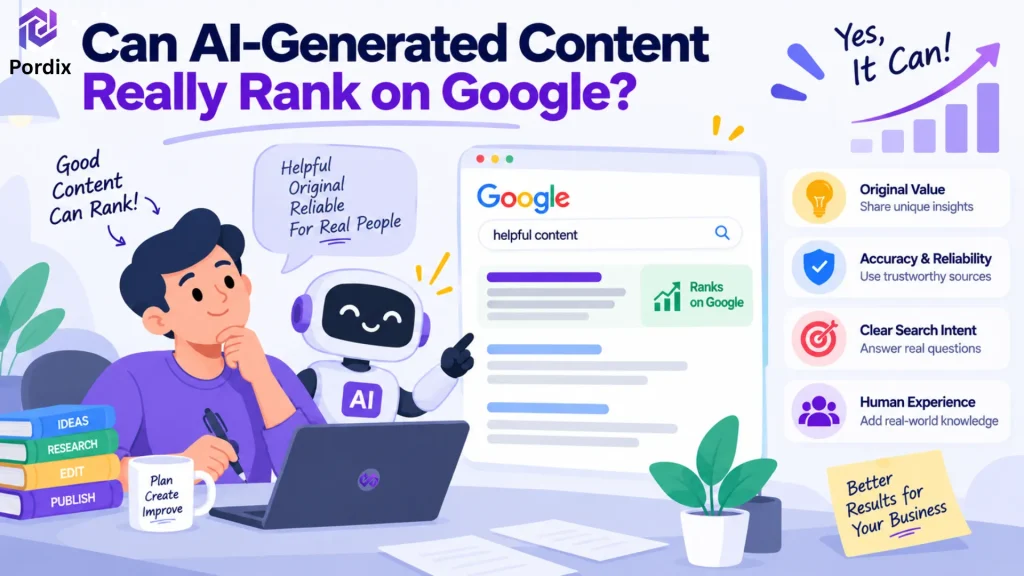
Yes, AI-generated content can rank on Google. But the technology behind it isn’t what decides success. Google doesn’t lower an article’s visibility just because AI helped write it. Instead, Google looks at whether the content is helpful, reliable, original, and built around what users are actually searching for.
The real difference between AI content that ranks and AI content that doesn’t comes down to process. A raw AI draft with no editing, no fresh insight, and no real understanding of the reader will likely struggle. But content that pairs AI’s speed with human expertise, solid research, and careful editing has a much better shot at ranking well.
What Makes AI Content Valuable for Search Rankings?
When it comes to AI-generated content and SEO, the goal isn’t more pages. It’s better ones. Google’s systems are built to spot content that gives users real, accurate answers.
Here’s what matters most:
- Original, useful information – Share insights or examples readers can’t easily find elsewhere.
- Accuracy and reliability – Back up claims with trustworthy sources, and double-check for errors.
- Clear search intent alignment – Answer the actual question people are typing into Google.
- Human experience and expertise – Add real examples, expert input, and practical knowledge to build trust.
AI works best as a tool, not a final author. It’s great for research, structure, and speeding up early drafts. But the content still needs a human touch before it’s ready to earn its place on page one. These small things are the ones that matters when it comes to how Ai contents ranks on Google.
How Google Evaluates AI-Generated Content
Google’s systems are designed to surface useful results, regardless of whether AI helped create the content. That means the important question is not who or what wrote the first draft, but whether the finished article gives readers a useful and trustworthy answer.
Quality becomes especially important when an article covers topics that require expertise or can affect people’s decisions. Unsupported claims, vague explanations, and recycled information can weaken trust. Strong sources, accurate details, clear authorship, and genuine expertise give the content a more reliable foundation.
The Signals That Matter
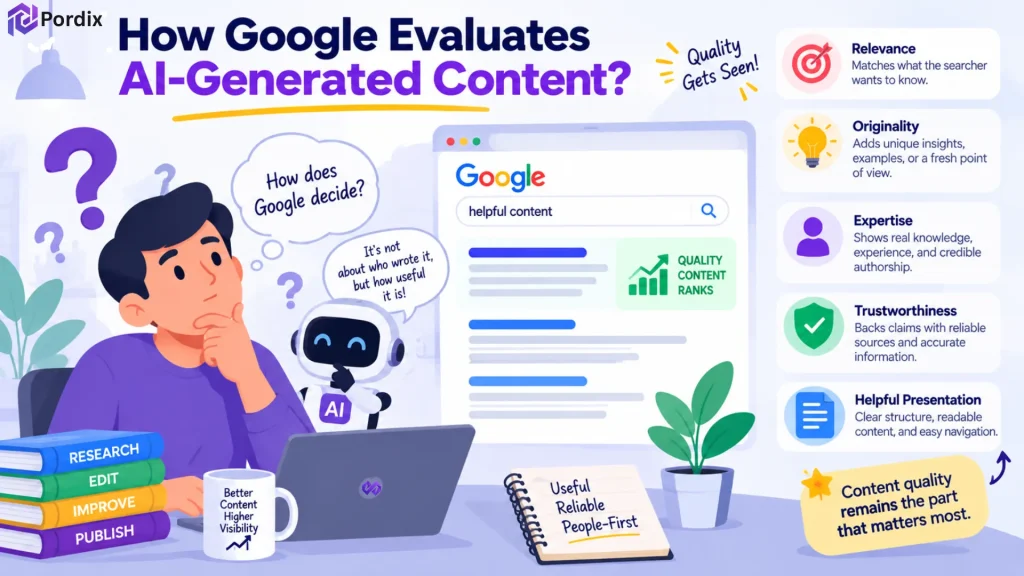
- Relevance: The article should closely match what the searcher wants to know. Adding information that does not support the main intent can make the page less useful.
- Originality: AI can summarize existing information, but strong content should add something of its own. Examples, analysis, experience, and useful observations can give an article a distinct point of view.
- Expertise: Content should demonstrate an appropriate level of knowledge. Author credentials, first-hand experience, expert commentary, and careful research can strengthen this signal.
- Trustworthiness: Readers should be able to understand where important claims come from. Credible references, factual accuracy, transparent authorship, and honest explanations all contribute to trust.
- Helpful presentation: Good information still needs to be easy to use. Clear headings, readable paragraphs, useful examples, and logical navigation help readers find the answer without unnecessary effort.
These principles matter whether an article is written manually, created with AI assistance, or produced through a combination of both. The technology can change the workflow, but content quality remains the part that matters most.
Why Some AI Articles Rank While Others Struggle
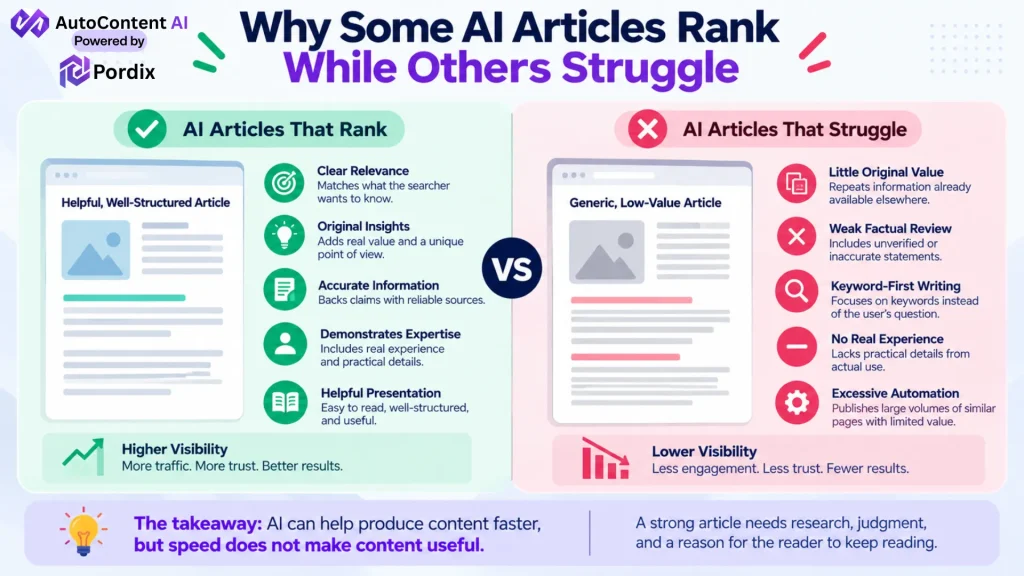
The presence of AI is rarely the deciding issue. The bigger problem is what happens when content is produced without enough research, context, or editorial judgment. An article can be grammatically polished and heavily optimized yet still offer little that a reader could use.
This is where AI content ranking factors become important when it comes to how Ai content rank on Google. Search visibility depends on the overall quality of the page, not how efficiently the first draft was produced. Content that answers a specific need, supports its claims, and adds useful information has a stronger foundation than pages created mainly to capture keywords.
Common Problems That Weaken AI Content
- Little original value: Repeating information already available across dozens of pages gives readers little reason to choose your article.
- Weak factual review: AI tools can produce confident statements that need verification. Publishing them without checking sources can damage accuracy and trust.
- Keyword-first writing: When keywords dictate the article instead of the user’s question, the writing can become unnatural and difficult to read.
- No real experience: Generic explanations often miss the practical details that come from actually using a product, testing a process, or working through a problem.
- Excessive automation: Publishing large volumes of similar pages without meaningful review can create a site full of content with limited value.
The lesson is simple: AI can help produce content faster, but speed does not make content useful. A strong article needs research, judgment, and a reason for the reader to keep reading.
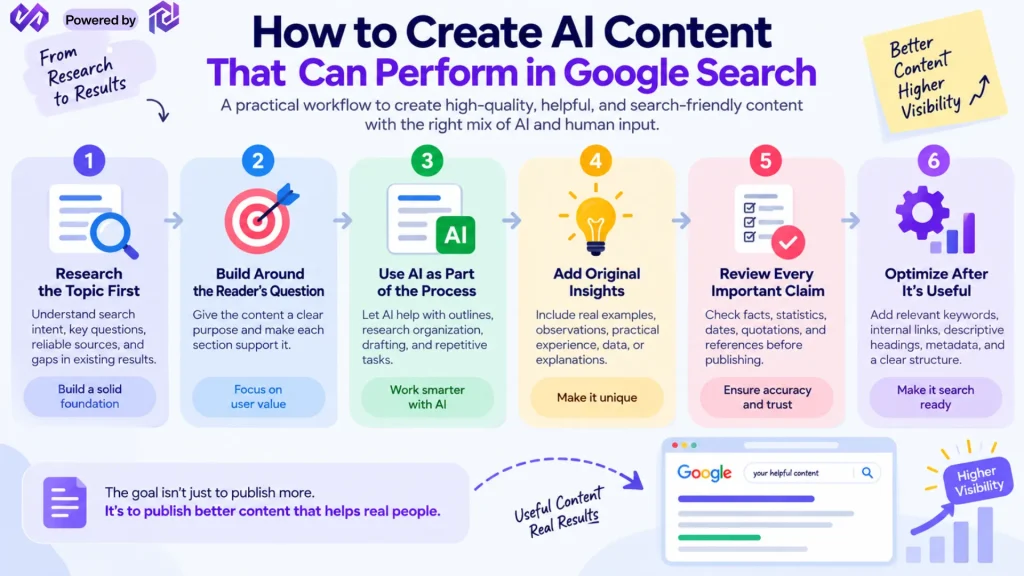
How to Create AI Content That Can Perform in Google Search
Creating AI-assisted content that performs well starts before the writing begins. The goal should be to understand what readers need, then use AI to make the research, drafting, and editing process more efficient.
A strong workflow keeps humans involved where judgment matters most. Research should establish the facts. AI can help organize ideas and build a draft. Human review can then add experience, verify claims, improve clarity, and remove anything that feels generic or unsupported.
A Practical Workflow for Better AI Content
- Research the topic first: Study the search intent, important questions, reliable sources, and gaps in existing results. This gives the article a useful foundation before any AI-generated text is created.
- Build around the reader’s question: Give the page a clear purpose and make each section support it. Avoid adding paragraphs simply because they contain another keyword.
- Use AI as part of the process: AI can help with outlines, research organization, drafting, and repetitive editing tasks. It should not replace the judgment needed to decide what belongs in the final article.
- Add original insight: Include examples, observations, practical experience, data, or explanations that give readers something beyond a summary of existing pages.
- Review every important claim: Check facts, statistics, dates, quotations, and references before publishing. Accuracy matters more than how quickly an article can be produced.
- Optimize after the content is useful: Add relevant keywords, internal links, descriptive headings, metadata, and structured information without changing the natural flow of the article.
The result should read like a useful piece of human work, not a machine-produced draft that was published unchanged. That distinction is important when learning how to optimize AI content for Google while keeping the reader at the center of the process.
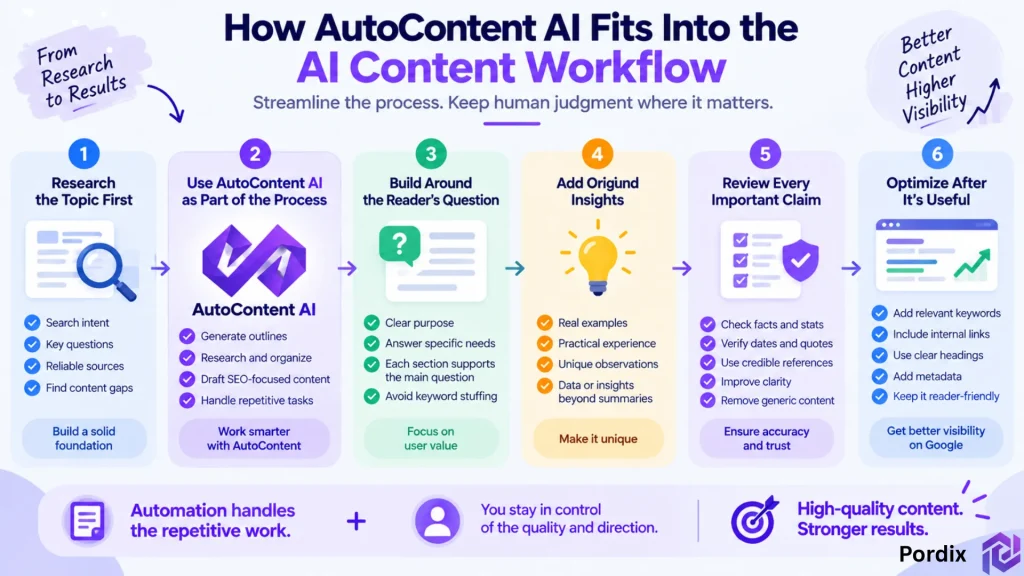
How AutoContent AI Fits Into the AI Content Workflow
The right AI workflow does not remove human input. It removes the repetitive work around it. Research still needs direction, important information needs review, and the final article should reflect the business behind it.
This is where AutoContent AI fits. It handles much of the production process by generating SEO-focused blog articles and publishing them directly to platforms such as WordPress and Shopify. Businesses can then spend more time reviewing, refining, and adding the input that makes their content genuinely useful.
The distinction matters. Automation should not mean publishing every generated draft without a second look. Topics still need a clear purpose, facts should be checked, and the final article should match the audience and brand.
Used this way, AutoContent AI becomes part of a broader content workflow rather than a replacement for editorial judgment. It takes care of repetitive production work while leaving businesses in control of the quality and direction of what they publish.
Final Thoughts
AI content does not have to be a disadvantage in search. When it comes to how Ai content rank on Google, the quality of what gets published and whether it genuinely helps the person who searched for it are the priorities.
AI can make content production faster. But research, accuracy, originality, experience, and thoughtful editing still matter. Publishing quickly should not mean sacrificing quality, especially when a website is trying to build lasting search visibility.
For a closer look at that balance, read our guide on autoblogging speed vs. quality and how automated publishing can be approached without losing sight of useful content.
The goal is not to publish more simply because AI makes it possible. The goal is to publish better content, more consistently, with a process that gives every article a reason to exist.
FAQs
1. Can AI-generated content rank on Google?
Yes. AI-generated content can rank on Google when it is useful, accurate, relevant to the search intent, and provides genuine value. Google’s systems focus on the quality and usefulness of the published page rather than simply whether AI was involved in creating it.
2. Does Google penalize AI-generated content?
No, AI use alone does not automatically result in a ranking penalty. Problems can arise when AI is used to produce large amounts of low-value, repetitive, inaccurate, or search-engine-first content. The focus should be on creating helpful content rather than publishing pages simply to manipulate rankings.
3. How does Google evaluate AI-generated content?
Google evaluates content based on factors such as relevance, helpfulness, originality, accuracy, and trustworthiness. AI content ranking factors also include how well the page satisfies the user’s search intent and whether it provides information that is genuinely useful rather than simply repeating existing material.
4. How can you optimize AI content for Google?
Start with the searcher’s actual question and build the article around it. Research the topic, use reliable sources, add original insights and practical examples, verify important claims, improve the writing through human review, and then apply SEO elements such as relevant keywords, descriptive headings, internal links, and useful metadata.
5. How Ai content rank on Google?
There is no single ranking factor that guarantees a higher position. Content has a stronger foundation when it combines AI efficiency with human expertise, original information, factual accuracy, clear search intent, and a useful reading experience. AI can speed up production, but the value of the finished article is what matters most.