
Why AI Automation Projects Fail: Common Mistakes and How to Avoid Them
AI automation has become a major opportunity for businesses looking to improve efficiency. Companies use artificial intelligence to reduce manual work, speed up operations, and create smoother workflows. However, not every automation initiative delivers the expected results. Many AI automation projects fail despite investment in software, planning, and resources.
The reason is often not the technology itself. Problems usually begin with unclear goals, poor process selection, weak data, or unrealistic expectations about what AI can achieve. Successful automation requires more than adding an AI tool. It requires understanding the workflow, choosing the right processes, and measuring whether the change creates real value.
A strong automation strategy improves how work gets done. It connects people, processes, and technology instead of simply replacing manual tasks. Understanding why automation projects fail helps businesses avoid costly mistakes. It allows teams to make better decisions before investing in new systems.
In this guide, we will explore the common reasons AI automation projects fail and how businesses can build more reliable automation strategies that deliver measurable results.

Why AI Automation Projects Fail Despite Growing AI Adoption
AI adoption is growing faster than ever. Businesses are exploring automation to reduce manual work, improve efficiency, and create smoother operations. But investing in AI tools alone does not guarantee success.
Many AI automation projects fail because companies focus on the technology before understanding the process. They choose a solution before identifying the actual problem, the expected outcome, or how success will be measured.
The strongest automation strategies start with a simple question: What part of the workflow needs improvement? From there, businesses can decide where AI can create real value.
When automation is connected to clear goals, reliable data, and practical workflows, it becomes more than another software investment. It becomes a system that helps people work better and creates measurable improvements.
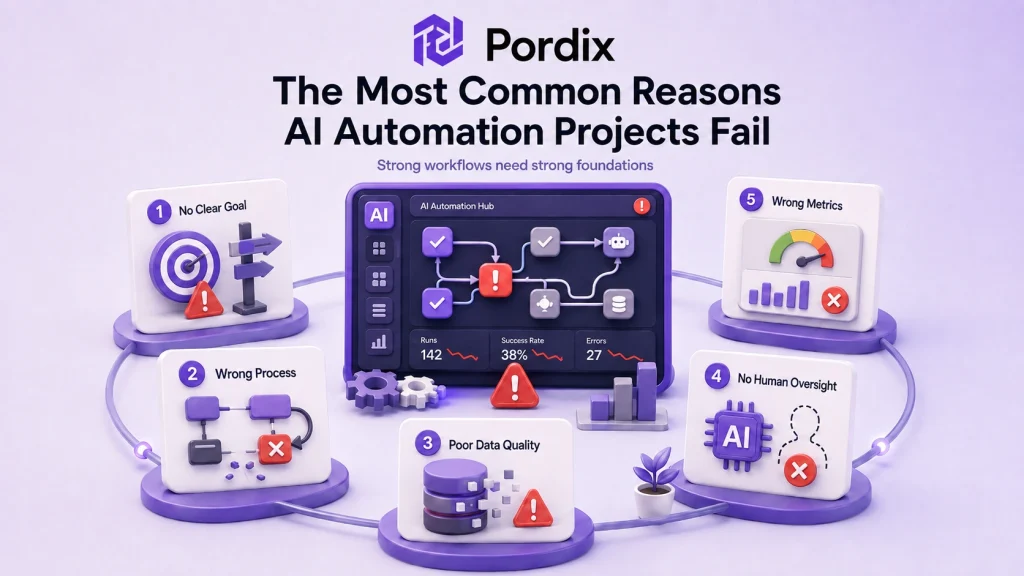
The Most Common Reasons AI Automation Projects Fail
The biggest automation failures usually do not happen because AI is incapable. They happen because businesses skip important steps before and during implementation.
An automation system can only perform well when the foundation behind it is strong. Without clear goals, suitable workflows, accurate data, and proper planning, even advanced AI solutions can create more frustration than value.
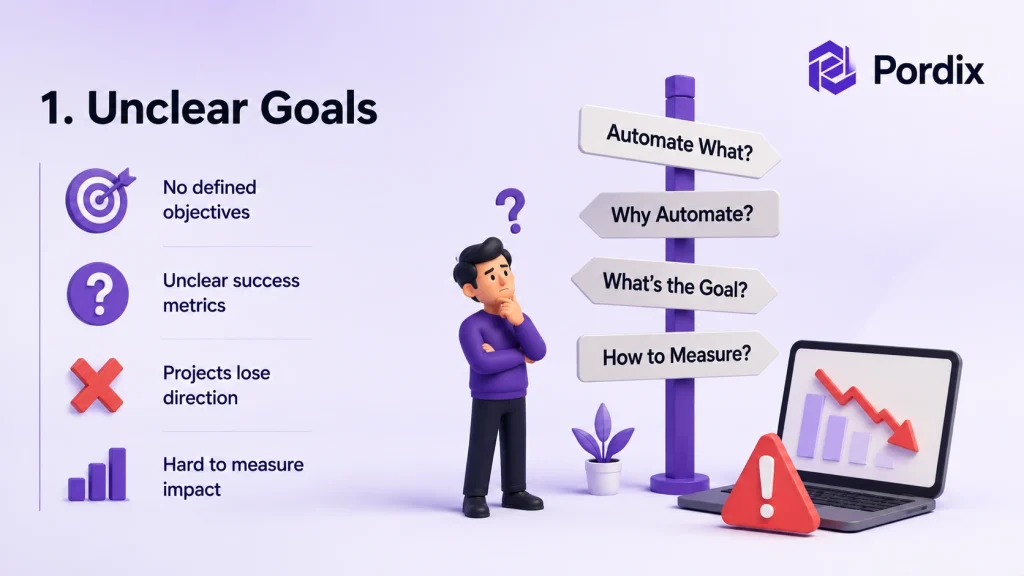
Building Automation Without a Clear Goal
A common mistake is starting with the question, “How can we use AI?” instead of asking, “What problem are we trying to solve?”
Without a defined goal, businesses may automate tasks that have little impact or invest in solutions that do not improve the workflow.
Successful AI automation projects need a clear purpose. Whether the goal is reducing response time, improving productivity, or lowering operational costs, the expected outcome should be identified before choosing a solution.
Automating the Wrong Process
Not every workflow is ready for automation. Some processes are still changing, poorly organized, or depend heavily on human judgment.
Automating a broken process often makes the problem happen faster instead of solving it.
Businesses should first understand how a task works, where delays happen, and which steps create unnecessary effort. The best automation opportunities usually come from repetitive, predictable workflows with clear outcomes.
Ignoring Data Quality and Preparation
AI systems depend on the information they receive. Poor-quality data can lead to inaccurate outputs, inefficient decisions, and unreliable results.
Businesses should review their data sources before implementation. Clean, organized, and accessible information creates a stronger foundation for AI-powered workflows. Without proper data preparation, even advanced AI tools may struggle to deliver consistent results. A strong data foundation helps automation systems produce more accurate outcomes and support better business decisions.
Expecting AI to Replace Human Judgment Completely
AI can handle many repetitive tasks, but human involvement still matters. Some decisions require context, creativity, and experience that automation cannot fully replace.
The most effective systems combine AI efficiency with human oversight. This balance creates more reliable workflows and helps teams maintain control over important decisions. Human review also helps identify mistakes, improve outputs, and ensure that automation continues to support the original business goals. AI should enhance human capabilities, not remove the judgment needed for complex situations.
Measuring Activity Instead of Business Results
Launching an AI tool is not the same as achieving success. A project should be measured by the value it creates and the problems it actually solves.
Businesses should track outcomes such as time saved, improved accuracy, reduced costs, or better customer experiences. These metrics make it easier to understand whether the investment is producing a meaningful AI automation ROI.
Results should also be reviewed over time. A workflow that performs well today may need adjustments as business needs change. A successful automation strategy focuses on measurable outcomes, not simply the number of tasks automated.
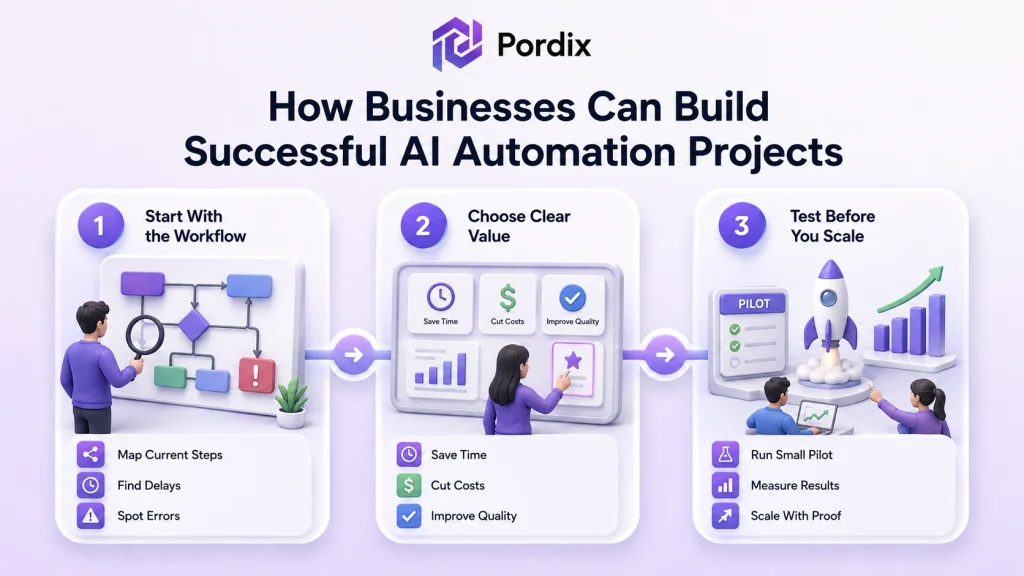
How Businesses Can Build Successful AI Automation Projects
Avoiding common mistakes is only part of the solution. Businesses also need a clear way to move from an automation idea to a system that works reliably in daily operations.
Start With the Workflow, Not the Technology
Before choosing an AI platform, study how the current process works. Look for delays, repeated manual steps, and points where errors happen most often.
This makes the purpose of automation much clearer. Instead of forcing AI into a process, teams can focus on the exact areas where technology can improve speed, accuracy, or consistency. It also reduces the risk of investing in software that does not solve the real problem.
Choose Opportunities With Clear Business Value
Not every task that can be automated should be automated. The best opportunities are usually the ones that create a visible improvement in time, cost, or output quality.
Frequent tasks, predictable workflows, and costly bottlenecks are often strong candidates. The expected result should also be measurable. This could mean fewer manual hours, faster response times, lower operating costs, or fewer mistakes. Clear value helps teams decide which ideas deserve priority.
After all, the repetitive workflow should be handled by the AI while your human team gets the time to think for new growth strategies.
Test Before You Scale
Large automation projects carry more risk when the process has not been tested properly. Starting with a smaller use case gives teams a chance to see how the system performs in real conditions.
Early testing can reveal technical issues, weak points, or steps that still need human input. Those problems can be fixed before the automation expands. A small pilot also makes it easier to compare expected results with actual performance before committing more budget and resources.
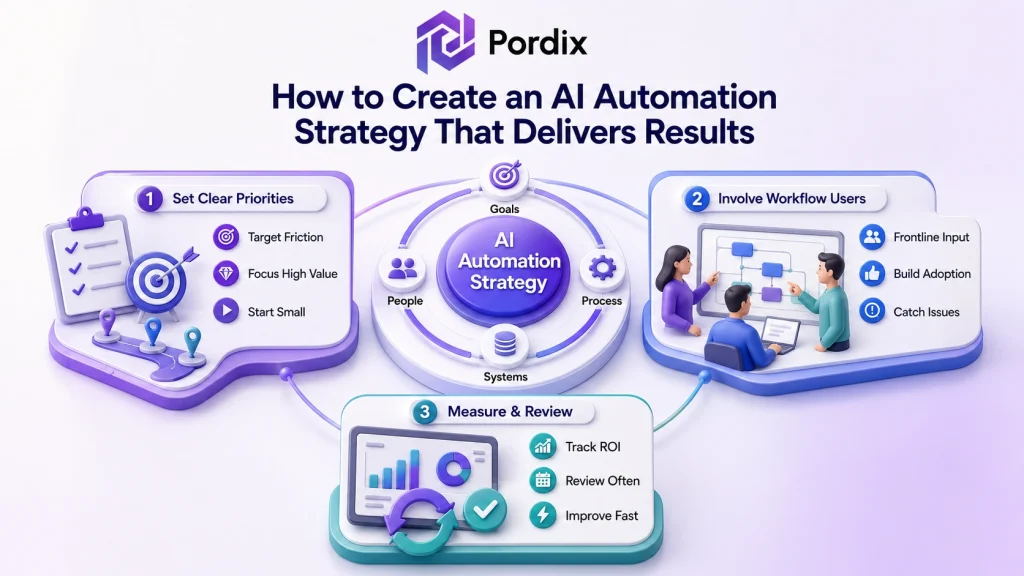
How to Create an AI Automation Strategy That Delivers Results
A strong AI automation strategy connects business goals with the people, processes, and systems needed to achieve them. It gives teams a clear direction before they invest more time or budget into new automation.
The strategy should define what needs to improve, who will use the system, and how success will be measured. It should also explain what should stay under human control. This keeps automation focused on business value instead of becoming another technology experiment.
Set Clear Priorities
Start with the workflows that create the most friction or consume the most time. These areas usually offer the clearest opportunity for measurable improvement.
Trying to automate too many processes at once can spread resources too thin. A smaller set of well-chosen priorities makes implementation easier to manage and improves the chances of success. It also makes it easier to compare results and learn what works before expanding further.
Involve the People Who Use the Workflow
The employees who work with a process every day often understand its problems better than anyone else. Their input can reveal delays, exceptions, and practical issues that may not appear in a process map.
Involving users early can also improve adoption. People are more likely to trust and use an automation system when they understand why it exists and how it supports their work. Their feedback can also expose small usability issues before they become bigger problems.
Measure and Review Performance
Automation should be reviewed after launch, not left to run without evaluation. Businesses need to compare actual results with the goals set at the beginning.
Track metrics such as time saved, error reduction, workflow speed, and AI automation ROI. Regular reviews make it easier to identify weak points and improve the system as business needs change. This also helps teams decide whether the automation should be expanded, adjusted, or replaced.
Choosing the Right AI Automation Tools for Your Business
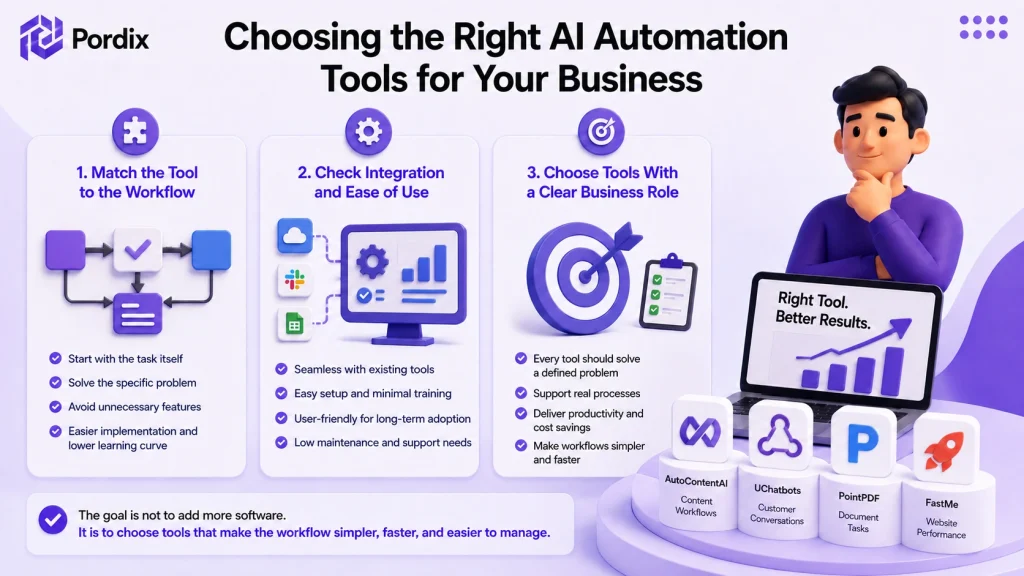
The right tool should fit the workflow, not force the workflow to fit the tool. Businesses should compare options based on the problem they need to solve, the complexity of the process, and how easily the software can work with existing systems.
Price matters, but it should not be the only factor. A cheaper tool can still create more work if it is difficult to use, requires too much setup, or does not match the way the team actually works. Here’s how you should choose the right tool for your business automation.
Match the Tool to the Workflow
Start with the task itself. A content process, document workflow, customer support system, and website performance issue all require different capabilities.
A useful tool should solve the specific problem without adding unnecessary steps. This is especially important for small teams, where extra complexity can slow down adoption.
Choosing a focused solution can make implementation easier and reduce the learning curve. It can also help businesses avoid paying for large feature sets they may never use.
Check Integration and Ease of Use
A useful automation tool should fit naturally into existing operations. Look at how it connects with current platforms, how much setup it needs, and whether employees can use it without constant support.
Ease of use also affects long-term adoption. A powerful system loses value if teams avoid using it because the interface feels confusing or the workflow is too complex.
Businesses should also think about maintenance. If the tool needs frequent fixes, manual adjustments, or technical help, those costs can reduce the value of the automation over time.
Choose Tools With a Clear Business Role
Every tool should have a reason to exist in the stack. It should solve a defined problem, support a real process, or replace work that takes too much time.
Pordix follows this focused approach with tools built around specific needs. AutoContent AI supports content workflows, UChatbots helps with customer conversations, PointPDF focuses on document tasks, and FastMe supports website performance.
This kind of role-based selection makes the software stack easier to understand. It also helps teams measure whether each tool is actually contributing to productivity, cost savings, or a smoother workflow.
The goal is not to add more software. It is to choose automation tools that make the workflow simpler, faster, and easier to manage.
Final Thoughts
Successful AI automation projects are rarely defined by the technology alone. The real difference comes from how well the business understands the problem, prepares the workflow, and measures the results after launch.
The strongest automation efforts usually have clear goals, reliable data, realistic expectations, and people who understand how the system fits into their work. These elements reduce the risk of wasted investment and make it easier to improve the process over time.
Businesses should also avoid treating AI as a one-time implementation. Workflows change. Teams grow. Customer needs shift. Automation should be reviewed and refined as those changes happen.
A practical AI automation strategy keeps the focus on measurable value. The goal is not to automate the most tasks. It is to improve the right processes in a way that saves time, reduces friction, and supports better business outcomes.
Frequently Asked Questions
Why do AI automation projects fail?
AI automation projects often fail because the problem is not clearly defined before implementation. Other common causes include poor data quality, weak planning, choosing the wrong process, and setting unrealistic expectations. A project has a better chance of success when the workflow, goal, and success metrics are clear from the beginning.
What are the biggest AI automation mistakes businesses make?
Some of the biggest AI automation mistakes include automating unstable processes, choosing tools before understanding the workflow, ignoring employee input, and measuring activity instead of business value. These mistakes can make automation more complex without improving the actual process.
How can a business improve its AI automation strategy?
A strong AI automation strategy starts with a clear business problem. Teams should define the expected outcome, choose a suitable workflow, involve the people who use it, and test the system before scaling. Performance should then be reviewed using measurable results such as time saved, fewer errors, or lower operating costs.
How long does it take to see ROI from AI automation?
There is no fixed timeline for AI automation ROI. It depends on the complexity of the workflow, implementation cost, adoption rate, and the value of the task being automated. Smaller and more focused projects can often be evaluated sooner because the expected results are easier to measure.
Can Pordix help with a custom AI automation workflow?
Pordix focuses on practical automation tools for real workflow needs. If an existing product does not fit the process, businesses can contact Pordix to discuss a workflow, bottleneck, or automation idea. Sharing the current process, repeated tasks, and desired outcome can make it easier to explore whether a focused automation solution is practical.