
How Pordix Helps Small Businesses Automate Repetitive Work
Running a small business means doing five jobs at once. You’re answering customer messages, updating the website, writing content, and prepping documents — often before lunch. None of that work disappears on its own, and hiring for every task isn’t realistic for most small teams.
Business automation tools exist to close that gap. They don’t replace your judgment or your voice. They take the repeatable, rules-based parts of your day — the tasks you’ve done the same way a hundred times — and handle them in the background while you focus on decisions only you can make.
Pordix builds four of these tools with that exact goal: less repetition, more control. This guide breaks down where repetitive work actually slows small businesses down, which tasks are safe to automate, and which ones still need a human hand.

Where Repetitive Work Creates Business Friction
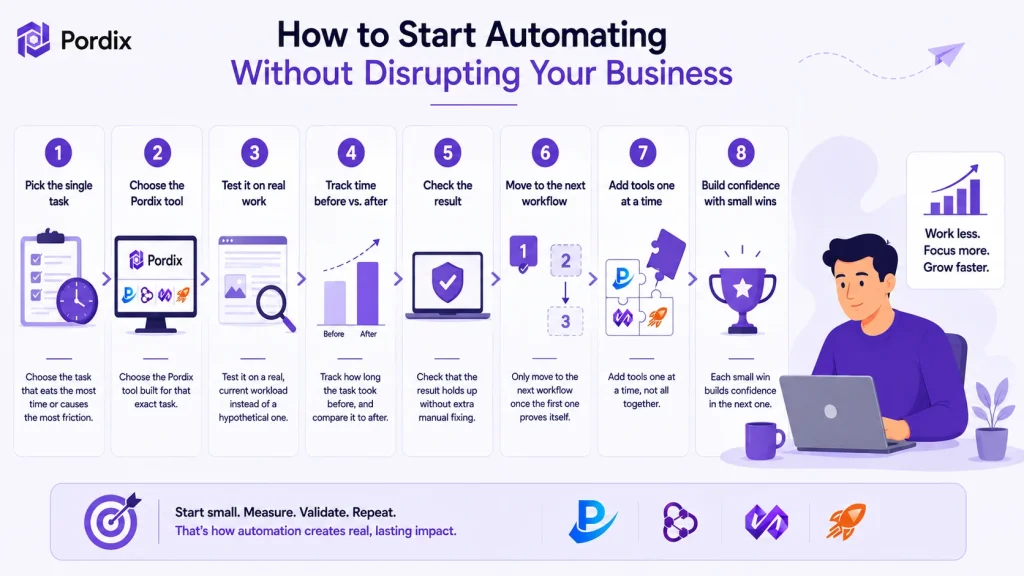
Most repetitive work doesn’t look like a problem on any single day. It’s a five-minute task here, a “quick fix” there. The trouble shows up over weeks, when those small tasks pile into hours you never planned to spend.
A few examples show up in almost every small business:
- The website slows down after every new plugin or image upload, and nobody has time to track down why.
- Blog posts and product updates sit in drafts because publishing takes longer than writing.
- The same three or four customer questions come in daily, pulling attention away from harder requests.
- Documents need sensitive details removed before they go out, and doing it by hand invites mistakes.
None of these tasks are hard. They’re just repeated, and repetition is what quietly drains a small team’s time. Research backs this up: BCG found nearly 60% of workers believe automation could save them six or more hours a week on manual, repetitive work alone. For a small business with no room to spare, that’s not a minor gain — it’s the difference between reacting all day and actually planning.
This is where the right tools change the math, not by taking over the business, but by taking the repeated parts off your plate.
4 Repetitive Workflows Small Businesses Can Simplify
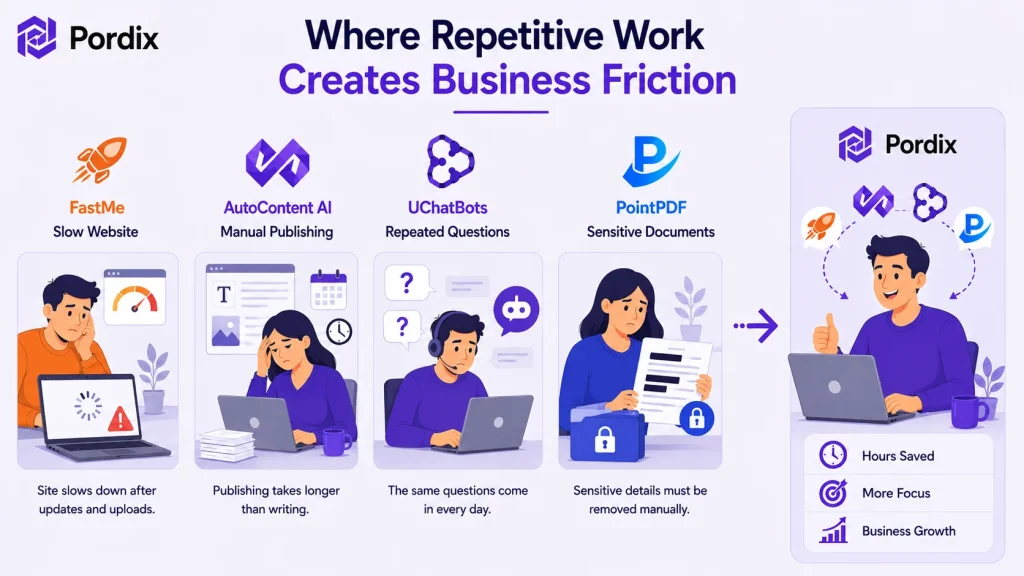
Not every task deserves the same fix. These four keep coming up across small businesses, and each one has a clear automation path using our workflow automation software.
Website Performance Tasks
A slow website costs more than patience — it costs visitors and sales. Page speed is one of the most measurable, most repetitive fixes a small business deals with, since every new image, plugin, or theme update can quietly drag load times down again. FastMe is built to handle this ongoing work, optimizing site speed so pages load fast without you manually auditing performance every time something changes. It’s the kind of task that benefits from being automated, not because it’s complex, but because it needs to happen constantly.
Content Creation and Publishing
Writing content is only half the job. Formatting it, adding images, scheduling it, and getting it live on WordPress takes real time every single week. AutoContent AI reduces that recurring publishing work, taking content from draft to a live WordPress post without the manual back-and-forth. It’s a one-time purchase rather than a recurring subscription, which matters for small businesses trying to keep software costs predictable while still publishing consistently.
Common Customer Conversations
Most customer messages are the same handful of questions: pricing, hours, order status, how something works. Answering these one by one, all day, pulls attention away from the conversations that actually need a person. UChatBots handles these routine, repeatable questions automatically, so your team only steps in when a request needs real judgment — a complaint, a custom quote, a situation that doesn’t fit a script.
Sensitive PDF Preparation
Sharing documents outside the business often means removing information first — account numbers, personal details, internal notes. Doing this manually, page by page, is slow and easy to get wrong. PointPDF helps hide selected information before a document goes out, turning a careful, repetitive task into a quick, reliable step instead of a source of last-minute stress.
What Small Businesses Should Keep Human-Led
Automation works best when it knows its limits. Some parts of running a business shouldn’t be handed off, no matter how good the tools get.
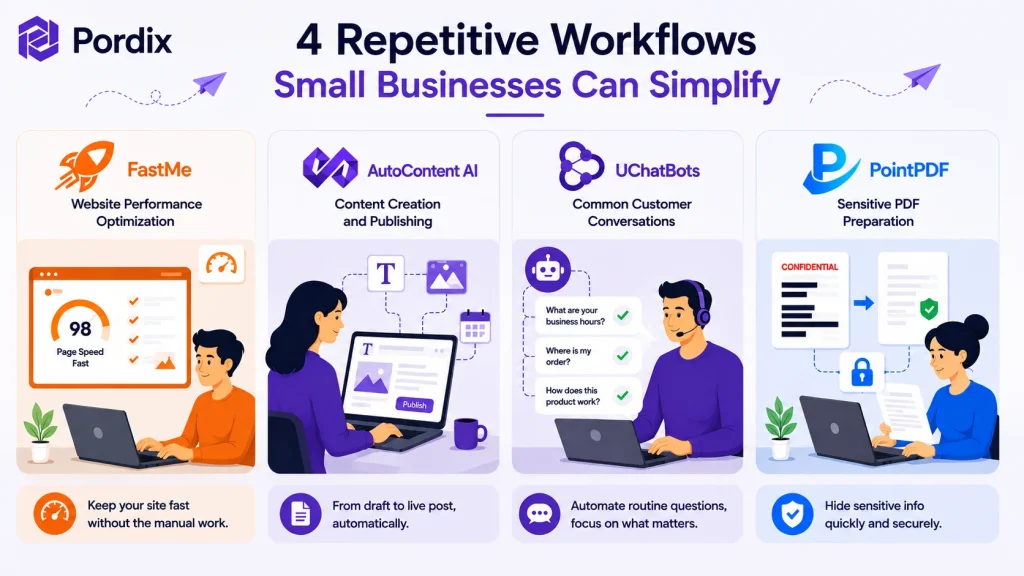
Strategy is one. Deciding what to focus on next, which customers to prioritize, or how to price a new offer needs context a tool doesn’t have. Fact-checking is another — automated content and AI-generated drafts still need a human read-through before they go live, especially anything tied to claims or numbers.
Sensitive decisions deserve the same care. If a task involves a customer’s money, health, or legal standing, a person should make the final call. Customer complaints fall here too. A chatbot can answer “what are your hours,” but a frustrated customer needs someone who can actually listen and adjust.
Privacy reviews matter just as much. Tools like PointPDF can hide information automatically, but someone should still confirm the right details were caught before a document goes out. And final approval — on content, on customer communication, on anything public-facing — should stay with a person, every time.
Ai automation tools for entrepreneurs should support these decisions with speed and consistency. It shouldn’t replace the judgment behind them. For small business automation, these are a must to improve their rankings, trust and authority across the search engines.
How to Use Business Automation Tools Without Disrupting Your Business
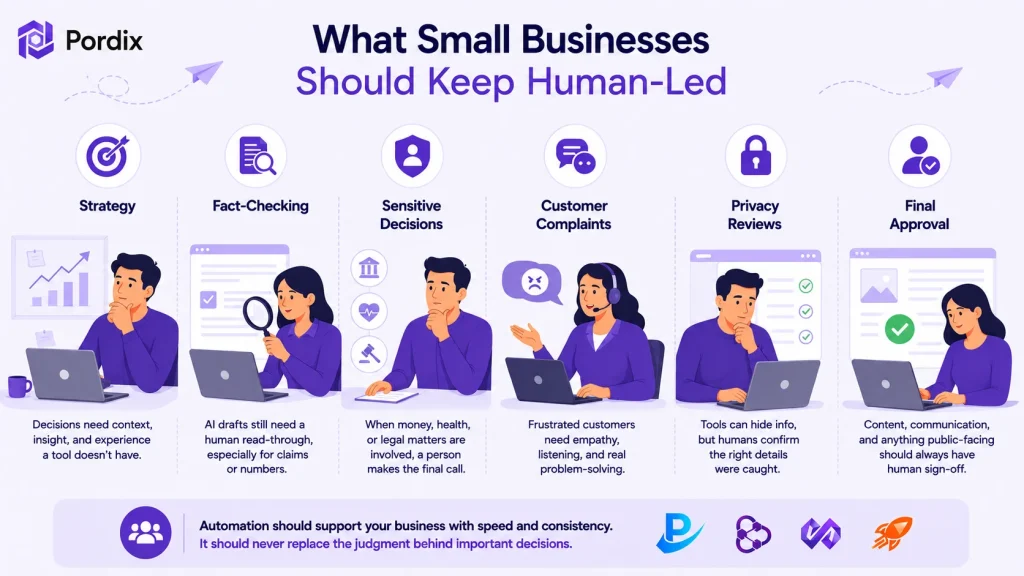
You don’t need to automate everything at once. One change at a time keeps things stable, so start small with our business automation tools and build from there.
- Pick the single task that eats the most time or causes the most friction — site speed, publishing, or repeat customer questions.
- Choose the Pordix tool built for that exact task.
- Test it on a real, current workload instead of a hypothetical one.
- Track how long the task took before, and compare it to after.
- Check that the result holds up without extra manual fixing.
- Only move to the next workflow once the first one proves itself.
- Add tools one at a time, not all together.
This slower approach protects what already works in your business. It also gives you real proof before you commit to more change. Each small win builds confidence in the next one. By the time you’re automating your third or fourth workflow, you’ll already know what “working well” looks like for your team. That’s a stronger foundation than trying to fix everything in one week.
Conclusion: Reduce Repetition Without Losing Control
Repetitive work isn’t the enemy — it’s just work that shouldn’t take up your best hours. A slow website, a backlog of unpublished content, the same customer questions, or a document that needs careful editing before it’s shared: these are the tasks automation was built for.
Pordix’s tools — FastMe, AutoContent AI, UChatBots, and PointPDF — each target one of these repeated jobs, so you can hand off the routine parts to your business automation tools and keep your attention on the decisions that actually need it. The goal isn’t to remove people from the process. It’s to make sure your time goes toward strategy, judgment, and the customers who need a real conversation, not another form.
Start with the one task that costs you the most time each week. Test the tool built for it. Measure the difference. Once that workflow proves itself, you’ll have a clear, low-risk way to decide what to automate next — without ever losing control of how your business runs.
Frequently Asked Questions
What is business automation, and how does it help a small business?
Business automation uses software to handle repeated tasks — like publishing content or answering common questions — without manual effort each time. For small businesses, it frees up hours that would otherwise go to routine work.
Which repetitive tasks should a small business automate first?
Start with whatever task costs the most time weekly. Site speed, content publishing, routine customer questions, and document prep are common first picks because the time savings show up fast.
Does business automation tools remove the need for human oversight?
No. Business automation tools handles routine, rules-based tasks well, but strategy, fact-checking, sensitive decisions, and final approvals should stay with a person.
How do you know if a workflow automation is actually working
Compare the task’s time and quality before and after. If it takes less time and the result holds up without extra fixes, the business automation tools are doing its job.
How can a small business start using Pordix's tools?
Pick the single tool that matches your biggest recurring task — FastMe for site speed, AutoContent AI for publishing, UChatBots for customer questions, or PointPDF for document prep — and test it on real work first.