
How Pordix Turns User Requests Into Practical AI Tools
Most AI tools begin with a feature. The better ones begin with a problem.
A business owner may be spending too much time on repetitive tasks. A team may need a faster way to manage content, documents, or customer messages. In cases like these, the real need comes first. The technology should come second.
This is the idea behind user-driven AI tools. They are shaped around real needs instead of being built only to follow trends. That can lead to more useful automation tools, clearer workflows, and a better user experience.
Pordix follows this practical direction by focusing on problems people actually face. Its goal is to turn useful requests into practical AI tools that can remove friction from everyday work.
In this article, we will look at how Pordix approaches that process and why building AI tools based on user needs can create more meaningful automation.

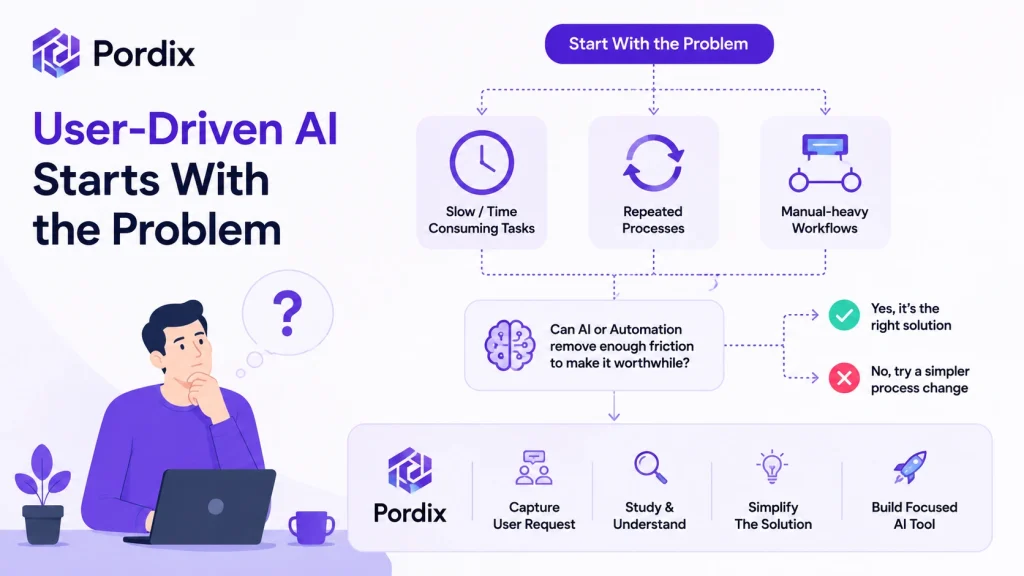
Why User-Driven AI Starts With the Problem
A useful AI tool should solve something people already struggle with. That could be a slow task, a repeated process, or a workflow that depends on too much manual effort.
The mistake is to begin with the technology and search for a reason to use it. User-driven development works in the opposite direction. It starts by looking at the actual problem. Then it asks whether AI or automation can remove enough friction to make the solution worthwhile.
This matters because not every task needs AI. Some problems are too small. Others are better solved with a simple process change. The strongest opportunities usually appear when a task happens often, takes valuable time, or creates avoidable delays.
For Pordix, this problem-first approach helps keep product ideas practical. A user request can reveal where a workflow is breaking down. That request can then be studied, simplified, and turned into a focused solution instead of becoming another feature added without a clear purpose.
The result is a more useful starting point for building user-driven AI tools: understand the work first, then decide how technology should help.
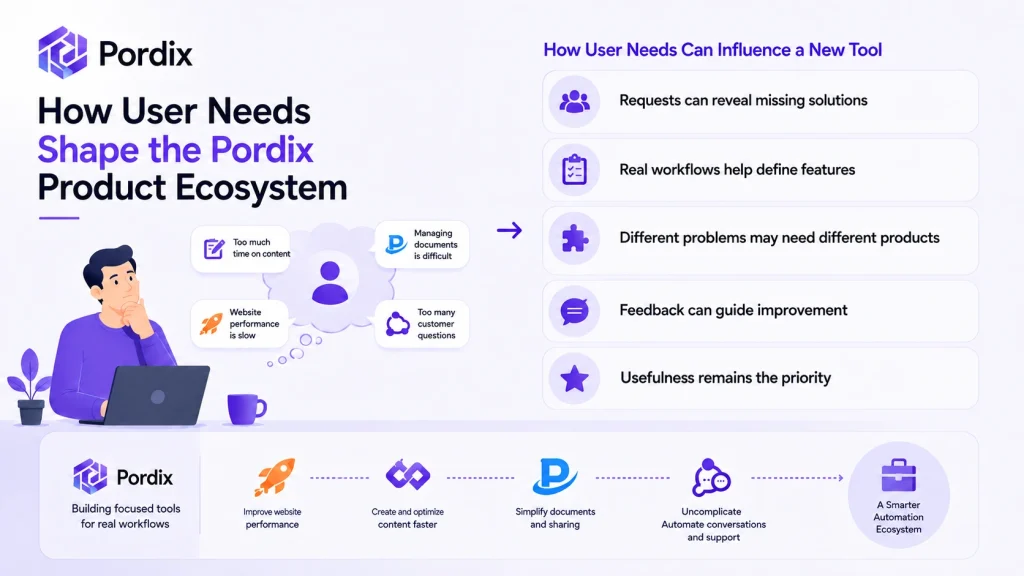
How User Needs Shape the Pordix Product Ecosystem
Understanding the problem is only the beginning. The next question is what type of solution fits it best. Instead of forcing unrelated workflows into one product, Pordix can use different needs to guide the development of focused tools.
How User Needs Can Influence a New Tool
- Requests can reveal missing solutions: Similar requests from users may point to a workflow that existing tools do not handle well.
- Real workflows help define features: Features can be shaped around what users actually need to complete a task rather than around unnecessary complexity.
- Different problems may need different products: Content, documents, website performance, and conversations each involve different workflows and may benefit from purpose-built tools.
- Feedback can guide improvement: Once a tool is being used, real experiences can reveal where the workflow still feels slow or difficult.
- Usefulness remains the priority: A product should earn its place by solving a clear problem, not simply by adding more AI features.
This approach allows the Pordix ecosystem to expand around practical demand. Each new tool can serve a defined purpose while still fitting into a broader automation ecosystem.
When a User Request Is Worth Building
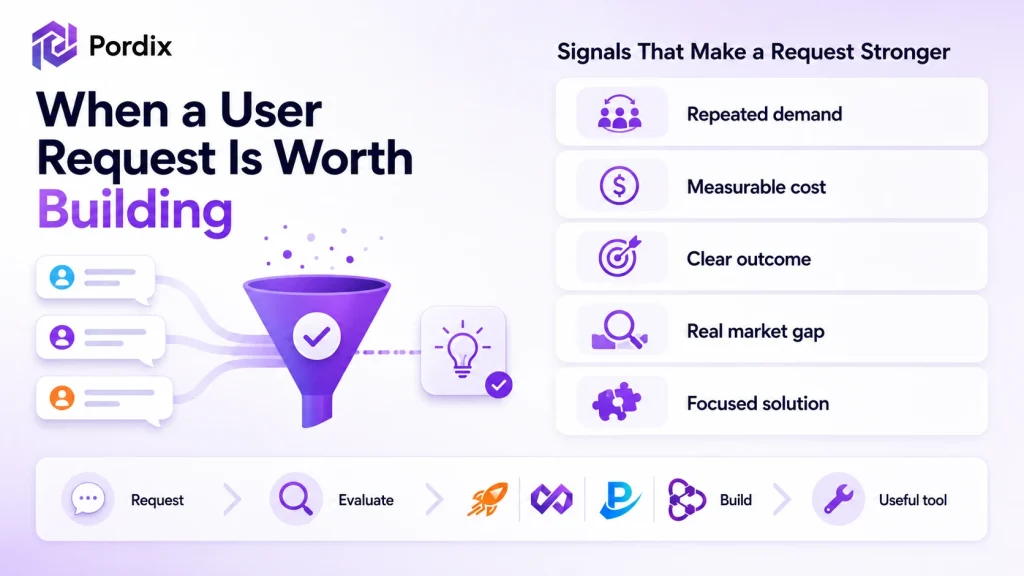
Not every request should become a product. A strong idea needs to solve a problem that is clear, recurring, and useful beyond a single situation. This is where product judgment becomes just as important as the technology behind the tool.
A request becomes more meaningful when the same need appears more than once or when the problem creates a noticeable cost. That cost could be lost time, repeated manual work, delays, or a process that is harder than it needs to be. Clear outcomes also matter. If users can easily explain what they want to achieve, it becomes easier to decide whether a dedicated tool can genuinely improve the process.
The market also plays a role. If existing solutions are too complex, too expensive, or poorly suited to a specific task, there may be room for a more focused alternative. In many cases, a smaller tool that performs one job well can be more useful than a large platform filled with features the user may never need.
For Pordix, this kind of filtering can help keep the product ecosystem practical and focused. The goal is not to turn every suggestion into software. It is to identify the requests with enough real value, demand, and purpose to justify building a tool around them.
Why Real-World Use Matters After Launch
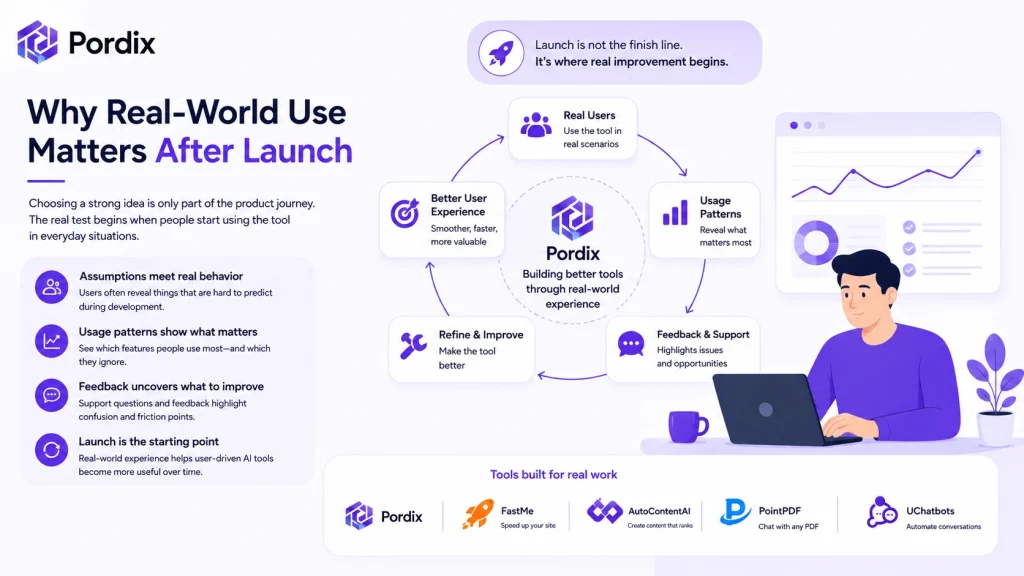
Choosing a strong idea is only part of the product journey. The real test begins when people start using the tool in everyday situations. This is where assumptions meet actual behavior.
Real users often uncover things that are difficult to predict during development. A feature may take too many steps. An option may be hard to find. A process that looked simple on paper may feel slower in practice. These details can shape the user experience as much as the main function of the tool.
Usage patterns can also reveal which parts of a product matter most. If people rely heavily on one feature while ignoring another, that provides useful direction. Support questions, recurring feedback, and common points of confusion can show where the product needs refinement.
For Pordix, this creates an opportunity to treat launch as a starting point rather than a finish line. User-driven AI tools can become more useful over time when real-world experience continues to influence how they improve.
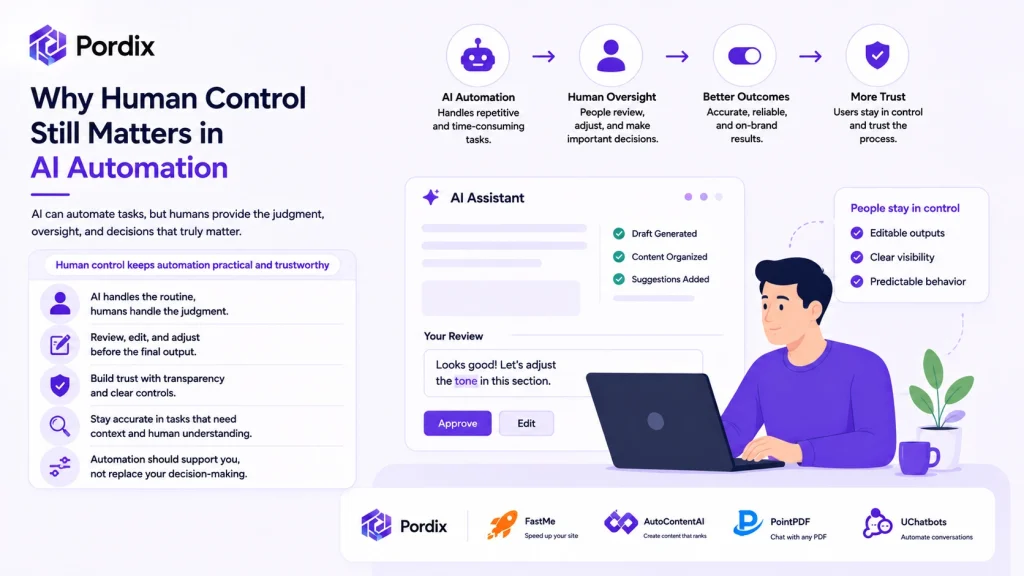
Why Human Control Still Matters in AI Automation
Even a useful automation tool should not remove people from every decision. AI can speed up routine work, organize information, and reduce repetitive effort, but users still need control over the final outcome.
That matters most when a task involves judgment, tone, accuracy, or customer-facing decisions. A faster process has little value if the result cannot be reviewed, corrected, or adjusted when needed. Good automation should support the user instead of making the workflow harder to understand.
This also affects trust. People are more likely to rely on a tool when they know what it is doing and can step in when something needs attention. Clear controls, editable outputs, and predictable behavior can make AI feel like part of the workflow rather than a system working around it.
For Pordix, keeping that balance can help make its automation tools more practical. The strongest AI experience is not always the one that automates the most. It is the one that saves time while leaving the user in control of the work that still needs human judgment.
Final Thoughts
The value of user-driven AI tools comes from how well they fit real work. A useful product does more than automate a task. It should reduce friction, stay easy to understand, and give people more control over how they get things done.
For Pordix, that means keeping the focus on practical needs rather than adding features for the sake of growth. Strong ideas can come from real requests, but their long-term value depends on how well they perform once people begin using them.
As the Pordix ecosystem grows, this approach can help each tool keep a clear purpose. The goal is simple: build practical AI tools that solve meaningful problems and improve everyday workflows without adding unnecessary complexity.
Frequently Asked Questions
What are user-driven AI tools?
User-driven AI tools are designed around problems people actually face rather than around AI features alone. The goal is to make a task easier, faster, or more manageable while keeping the product connected to a clear use case.
How do I know if a workflow is worth automating?
Start by looking for tasks that happen often, take up valuable time, or create delays for other work. A workflow is usually a stronger candidate when the result is predictable, and the same steps are repeated regularly.
Does an AI tool need to change after it is launched?
Often, yes. Real usage can reveal issues that are difficult to see during development. People may use features differently than expected, find unnecessary steps, or discover new use cases. Those insights can guide future improvements and create a better user experience.
Should AI handle every repetitive task?
No. Some repetitive work only needs simple automation. AI becomes more useful when the task involves language, interpretation, content, changing inputs, or decisions that traditional rules cannot handle efficiently. The technology should match the problem rather than make the workflow more complicated.
Can Pordix build an automation tool around my workflow?
If your business has a repetitive workflow or a software idea that existing tools do not solve well, you can discuss the requirement directly with Pordix. Pordix describes itself as a builder of practical automation software for real business problems and provides Contact Us forms across its website and product pages for direct enquiries.
When reaching out, it helps to explain what the current process looks like, where the bottleneck occurs, who uses it, and what result you want the automation to produce. This gives the Pordix team a clearer starting point for discussing a hands-on workflow automation solution.