
Live Chat vs Chatbots: Which Customer Support Approach Fits Your Business?
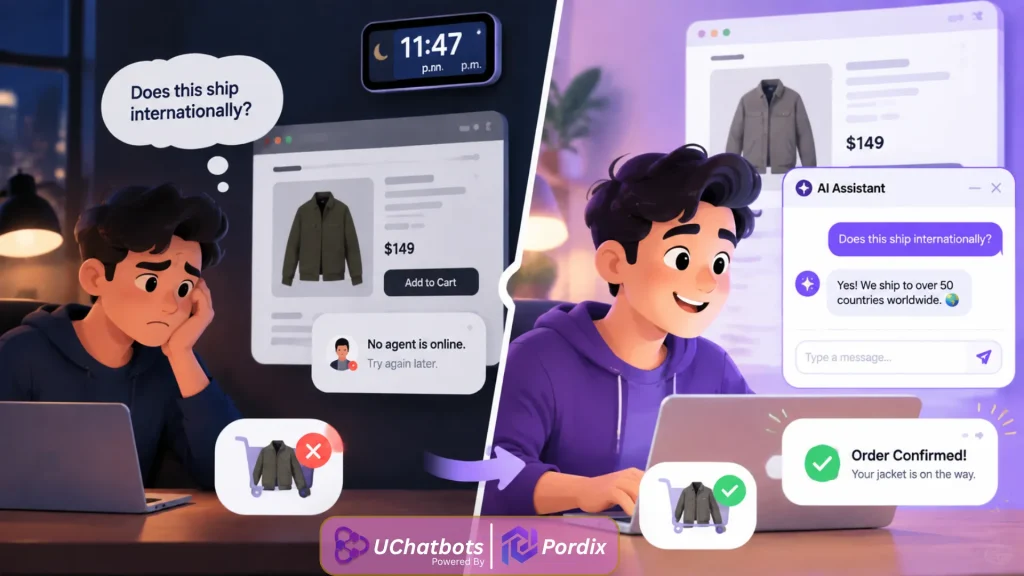
It’s 11:47 p.m. A visitor lands on an online store, adds a jacket to their cart, and stops. One question is stopping the sale: does this ship internationally? No agent is online. No phone line will pick up. In one version of this story, the visitor gives up and closes the tab. In another, a small chat bubble opens in the corner, answers the shipping question in under a second, and the sale goes through before midnight.
That gap between those two stories is where the live chat vs chatbots conversation actually lives. For years, businesses have treated this like a fork in the road: pick a team, human or machine, and build your support desk around it. That thinking is already out of date. The businesses winning on customer experience in 2026 aren’t choosing sides. They’re building systems where live chat and AI chatbots each do the part they’re genuinely good at.
This piece unpacks what live chat and chatbots actually are, where each one pulls ahead, and why the smartest support setups now blend both instead of picking one. By the end, the goal isn’t to crown a winner. It’s to help you figure out where each one belongs on your own website, based on how your customers actually behave, not on which option sounds more modern.
What Is Live Chat?
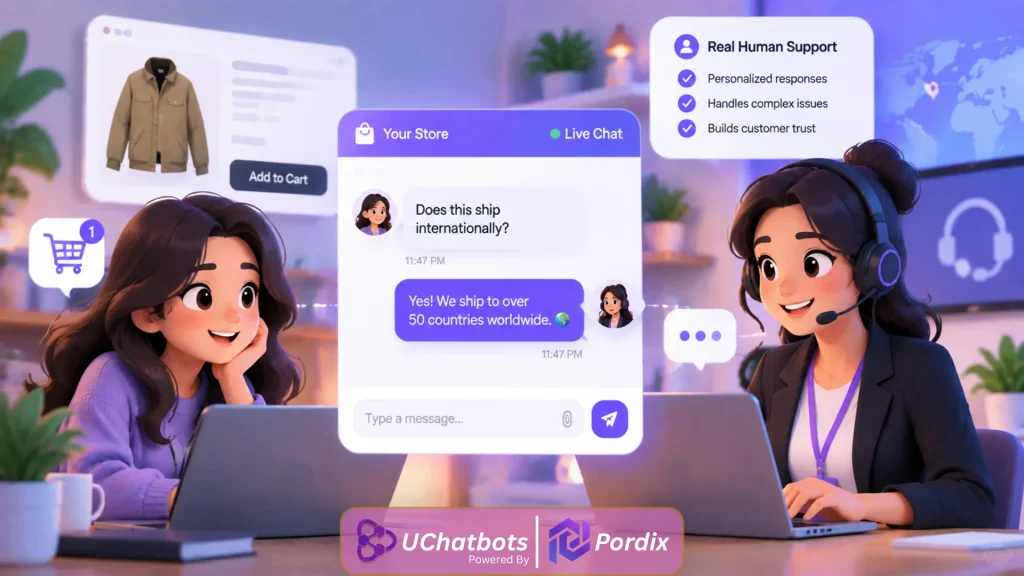
Live chat is the digital version of a shop assistant walking over to ask if you need help. A real person sits on the other end of the conversation, reading the customer’s message, typing a reply, and adjusting their tone based on how the customer feels in that moment.
That human presence is exactly what makes live chat strong. A frustrated customer can be talked down. A confusing situation, like a damaged order tied to a delayed refund, can be handled with judgment instead of a script. Live chat still earns the highest satisfaction score of any support channel, well ahead of email or phone, according to Zendesk-sourced live chat data.
The catch is availability. A live chat widget is only as fast as the agents watching it, and most support teams aren’t staffed around the clock. Nights, weekends, and sudden traffic spikes are where live chat starts to strain, and this is exactly where the customer support chatbot conversation begins.
There’s also a cost side to live chat that businesses tend to underestimate. Every agent added to a live chat rotation means another salary, another training cycle, and another person to schedule around holidays and sick days. None of that is a reason to avoid live chat. It’s a reason to be deliberate about which conversations actually need a human sitting behind them.
What Are AI Chatbots?
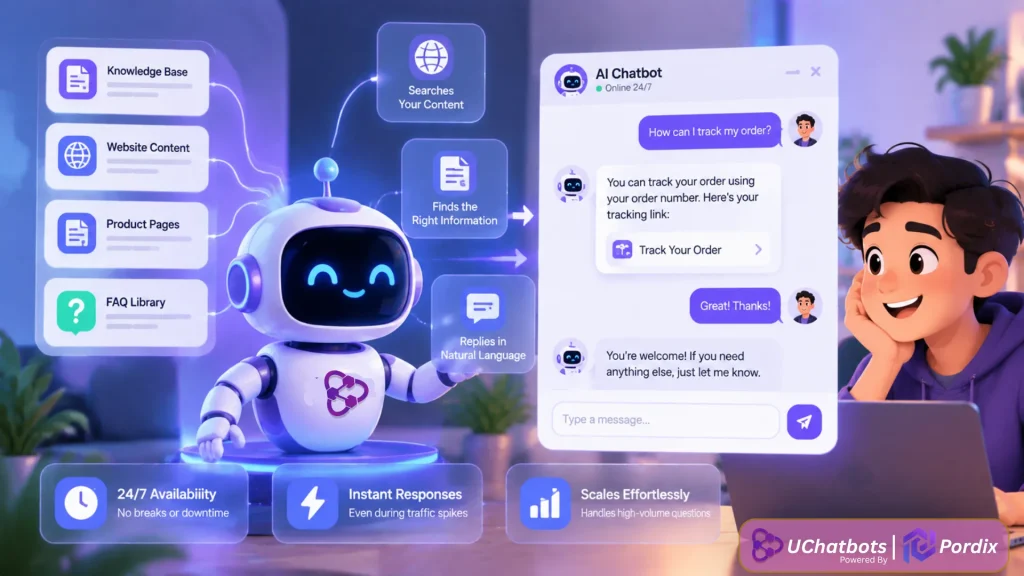
An AI chatbot handles a conversation without a person typing on the other side. Modern chatbots don’t just match keywords to canned answers anymore. They read the customer’s question, search a knowledge base or website content for the right information, and reply in natural language, often pulling from documents, product pages, or an FAQ library that used to sit unused on a support site.
This is what separates a real AI chatbot for customer support from the old-style scripted bots people learned to distrust. A modern chatbot can follow a visual workflow for structured tasks like order tracking, hand off to an autonomous AI agent for open-ended questions, or quietly search the live web when its own knowledge base comes up short. Turning a static FAQ page into a conversational assistant is one of the more overlooked upgrades a business can make, since most FAQ content already exists and needs a chatbot to make it searchable in plain language.
Chatbot automation shines exactly where live chat struggles: availability. A chatbot doesn’t sleep, doesn’t take breaks, and doesn’t get slower during a flash sale. That advantage is becoming more important as businesses move toward AI-powered customer support, with Gartner research showing that 91% of customer service and support leaders are under pressure from executive leadership to implement AI in 2026.
Live Chat vs Chatbots: Key Differences
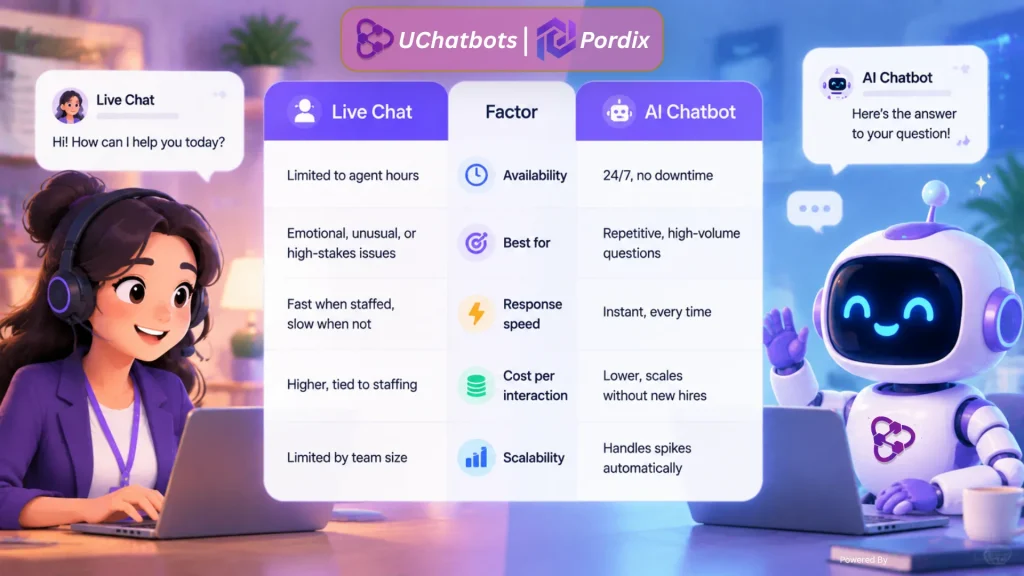
Placed side by side, the two approaches aren’t really competitors. They’re built for different jobs.
| Factor | Live Chat | AI Chatbot |
|---|---|---|
| Availability | Depends on agent working hours and team availability | Available 24/7 without breaks or downtime |
| Best for | Complex, emotional, or high-value conversations requiring human judgment | Repetitive questions, instant support, and high-volume requests |
| Response speed | Fast when agents are available, slower during busy periods | Instant responses at any time, even during traffic spikes |
| Cost per interaction | Higher costs as support volume increases with team workload | Lower operational costs by automating repetitive conversations |
| Scalability | Limited by the number of available support agents | Handles multiple conversations without adding staff |
Response Speed and Availability
Live chat response time depends entirely on who’s online. During business hours with a well-staffed team, replies can come back in under a minute. Outside those hours, or during an unexpected rush, wait times stretch, and visitors leave before anyone types a word.
Chatbots remove that variable completely. A chatbot for customer support responds instantly at 3 a.m. on a Sunday exactly as it would at 10 a.m. on a Tuesday. For a business trying to compete globally, where customers browse in every time zone, that consistency isn’t a nice-to-have anymore. It’s close to an expectation.
Handling Complex Conversations
This is where human chat vs AI chatbot debates usually land, and rightly so. A chatbot is excellent at answering “where is my order” or “what are your business hours.” It struggles the moment a conversation turns emotional or genuinely unusual, the kind of situation a customer can’t fully explain in a single message.
Human agents read tone, pick up on frustration before it boils over, and use judgment a script doesn’t have. Recent customer experience research keeps landing on the same point: humans still lead in emotional intelligence, creative problem-solving, and building real customer relationships, which is exactly why complaints, refunds tied to hardship, and anything reputation-sensitive still belong with a person.
Scalability During High Traffic
Picture a product launch, a holiday sale, or a viral moment that sends ten times the normal traffic to a website in an hour. A live chat team, however well trained, has a ceiling. Once every agent is in an active conversation, new visitors wait in a queue or give up entirely.
A chatbot doesn’t have that ceiling. It can hold a thousand conversations at the same moment it holds one. That’s a big reason AI chatbots have become standard on ecommerce sites, where traffic spikes are frequent, and every unanswered question is a lost sale waiting to happen.
Cost and Resource Management
Staffing a live chat team around the clock is expensive: salaries, training, shift coverage, and turnover all add up. Self-service and automated channels cost meaningfully less per interaction than agent-assisted support, and that gap is a major reason chatbot adoption keeps climbing. Businesses weighing this trade-off usually start by working out what an AI chatbot actually costs to run against what a fully staffed live chat desk costs to maintain, and the math rarely favors the all-human option once volume grows.
That said, cost isn’t the only metric that matters. A business also needs to know whether the automation is actually resolving issues, not just deflecting them. Measuring AI customer support ROI properly means tracking resolution quality alongside the savings, since a cheap answer that doesn’t solve the problem pushes the cost somewhere else.
Why Businesses Are Combining Live Chat With AI Chatbots
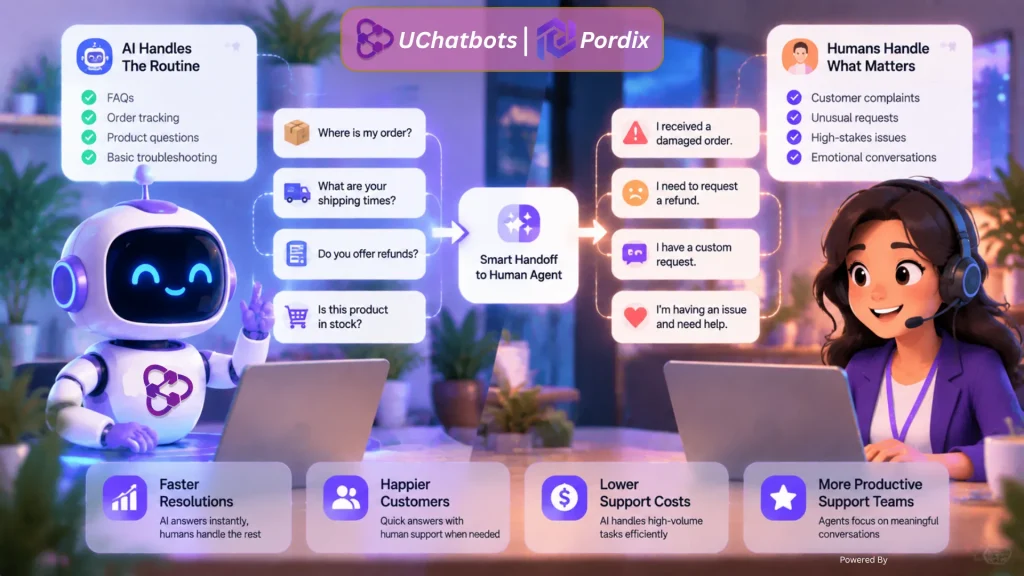
Here’s the shift that’s actually happening in 2026: the smartest support teams stopped asking “chatbot or human” and started asking “which parts of this conversation actually need a human.” McKinsey’s research on AI-powered virtual assistants found that 54% of companies now use them in at least one business function, and the gains show up fastest when AI handles the routine work so people can focus on what’s left.
The split usually looks like this. AI handles FAQs, order tracking, product questions, and basic troubleshooting- the high-volume, low-complexity traffic that used to eat up most of an agent’s day. Humans step in for complaints, unusual requests, and anything where trust and empathy matter more than speed.
What the Data Shows About the Hybrid Model
The data backs this up from both directions. Salesforce’s own research found that 88% of service professionals say AI accelerates resolution and 87% say it frees them up for complex work. At the same time, customers haven’t stopped wanting a human option. Gartner’s 2026 survey of thousands of customers found that 87% say it’s essential for a company to offer a path to a human agent even when it uses AI for support. That single number is the whole argument for a hybrid approach in one sentence: automate the routine, but never remove the exit door to a real person.
Businesses already running chatbots and human teams side by side, rather than treating one as a replacement for the other, tend to see this play out well. Pairing chatbots with human agents instead of pitting them against each other is quickly becoming the default playbook, not the exception, for teams that actually measure their support outcomes.
There’s a quieter benefit here too. When a chatbot clears out the repetitive questions, the conversations that do reach a human agent tend to be more interesting and less draining. Agents spend less of their day repeating the same shipping policy and more of it actually solving problems, which shows up in retention on both sides of the conversation, the customer’s and the agent’s.
How UChatbots Supports Smarter Customer Conversations
This is where a platform like UChatbots fits naturally into the picture, not as a replacement for your support team, but as the layer that handles everything routine so your team can focus on everything that isn’t.
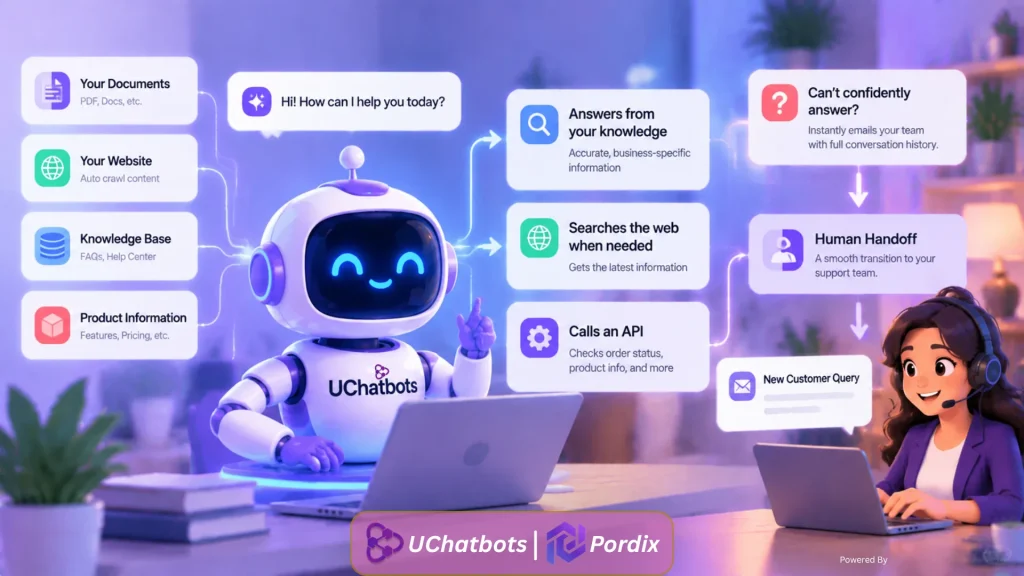
UChatbots builds chatbots that answer from a business’s own knowledge, whether that’s uploaded documents or a full website crawl, so replies stay grounded in accurate, business-specific information instead of generic guesses. Its visual workflow builder lets a business map out conversation logic without writing code, and its autonomous agent mode goes a step further: it decides on its own, turn by turn, whether to search the knowledge base, pull live information from the web, or call an API to check something like order status.
The detail that matters most for this exact live chat vs chatbots debate is human handoff. When a UChatbots conversation hits a question the bot can’t confidently answer, it doesn’t leave the customer stuck. It emails the business immediately with the full conversation history, so a human can step in without the customer having to repeat themselves from scratch. That one feature is the hybrid model in practice: automation for the routine, a fast bridge to a person for everything else. Getting a bot to that point usually starts with a straightforward website chatbot integration, which for most businesses is a single embed script rather than a development project.
How to Decide Which Support Model Fits Your Business
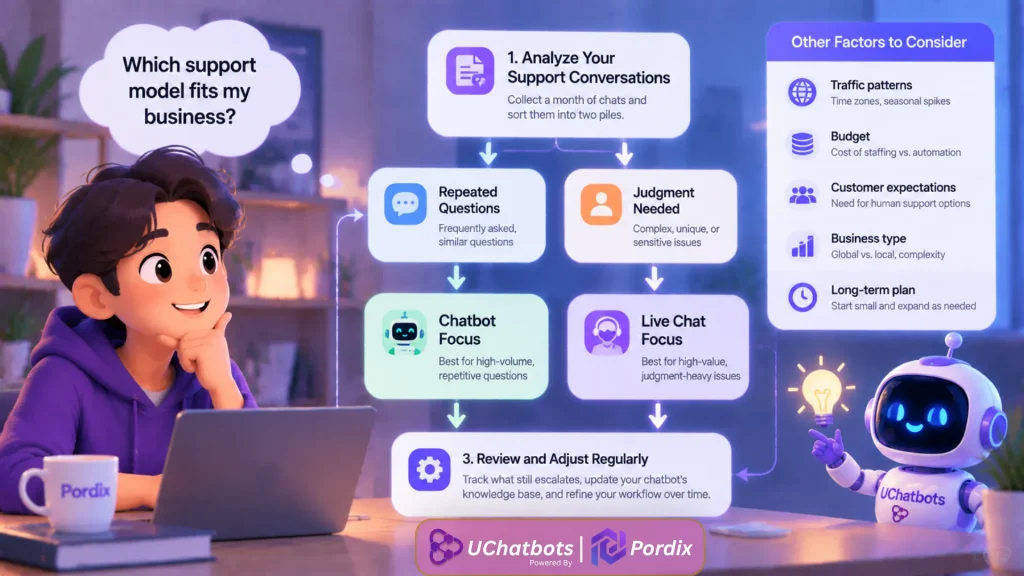
There’s no universal answer here, but there is a fast way to get close to the right one. Start by pulling a month of support conversations and sorting them into two piles: questions that are repeated word-for-word every week, and questions that needed real judgment to resolve. That split tells you almost everything.
- If the repetitive pile is large, a chatbot pays for itself quickly. It’s handling exactly the kind of volume that burns out human agents without needing much creativity to resolve. If the judgment pile is large, or your average order value is high enough that one lost or mishandled customer really stings, live chat staffing deserves the bigger share of your budget.
- Traffic pattern matters as much as question type. A business with visitors spread across time zones, or with sharp seasonal spikes, leans harder on a chatbot simply because no live chat team can staff for every peak. A local service business with steady, predictable hours might get by with live chat alone and add a chatbot later mainly for after-hours coverage.
- Whichever way the split falls, the decision isn’t permanent. Most businesses start with a chatbot handling FAQs and order status, watch which conversations still escalate to a human, and adjust the bot’s knowledge base or workflow every few weeks based on what it’s missing. That ongoing tuning matters more than getting the initial setup perfect.
Final Thoughts
The question businesses used to ask was simple, and slightly wrong: should we use chatbots or keep our live chat team? The better question, and the one worth actually answering, is how to use both so customers get faster answers without losing the human touch when it counts.
Live chat wins on empathy and judgment. Chatbots win on speed, availability, and scale. Put together, with a clear handoff between them, they cover far more ground than either one does alone. For businesses deciding which AI chatbot actually fits their size and workflow, the starting point isn’t picking a winner between human and AI. It’s designing the handoff between them well enough that customers never notice where one ends and the other begins.
That midnight jacket shopper from the start of this article doesn’t care whether a person or a chatbot answered the shipping question. They want the answer before they close the tab. Build your support around that reality, not around a preference for one side of the debate, and the “live chat vs chatbots” question mostly answers itself.
FAQs
Q1. Is live chat a real person?
Yes. Live chat connects a visitor directly with a human agent, even if some routing or ticket-assigning happens behind the scenes. A chatbot, by contrast, is software responding on its own, with no person typing the reply unless it hands the conversation off.
Q2. What is the difference between a chatbot and live chat?
Live chat is a human agent typing in real time. A chatbot is software that reads a message, checks a knowledge base or workflow, and replies automatically. The core difference isn’t the chat window; it’s who, or what, is actually answering behind it.
Q3. Is live chat better than a chatbot for customer support?
Neither is strictly better; they’re built for different situations. Live chat is stronger for emotional, complex, or high-stakes conversations because a human can read tone and adjust. Chatbots are stronger for speed, availability, and repetitive questions since they respond instantly, any hour of the day.
Q4. Why use live chat instead of a chatbot?
Live chat is the better choice when a conversation needs judgment a script can’t provide: an angry customer, an unusual request, or a sale that depends on trust. It’s slower to scale and more expensive to staff, but for high-stakes conversations, that human presence is what actually closes the gap.
Q5. Can a business use live chat and a chatbot together?
Yes, and this is increasingly the standard setup. A chatbot handles the first response and routine questions, then hands the conversation to a live agent when it hits something it can’t resolve confidently. Platforms with a human handoff feature make this switch smooth for the customer.
Q6. Do customers prefer talking to a human or a chatbot?
It depends on the situation. Many customers are comfortable with a chatbot for quick, simple questions, but most still want the option to reach a person, especially for anything sensitive or unresolved. That’s why removing human access entirely tends to backfire, even when a chatbot is technically capable.
Q7. How much does it cost to add a chatbot to a website?
Costs vary by platform, features, and conversation volume, but most modern chatbot tools are far cheaper per conversation than staffing a live chat desk around the clock. A closer look at current chatbot pricing is worth doing before comparing it against the cost of expanding a human team.
Q8. How do I choose between live chat and an AI chatbot for my website?
Start with your traffic pattern and question types. If most questions are repetitive and volume is unpredictable, a chatbot covers more ground for less cost. If your business handles frequent complex or sensitive conversations, live chat staffing matters more. Most growing businesses end up needing both, working together rather than as a replacement for one another.