
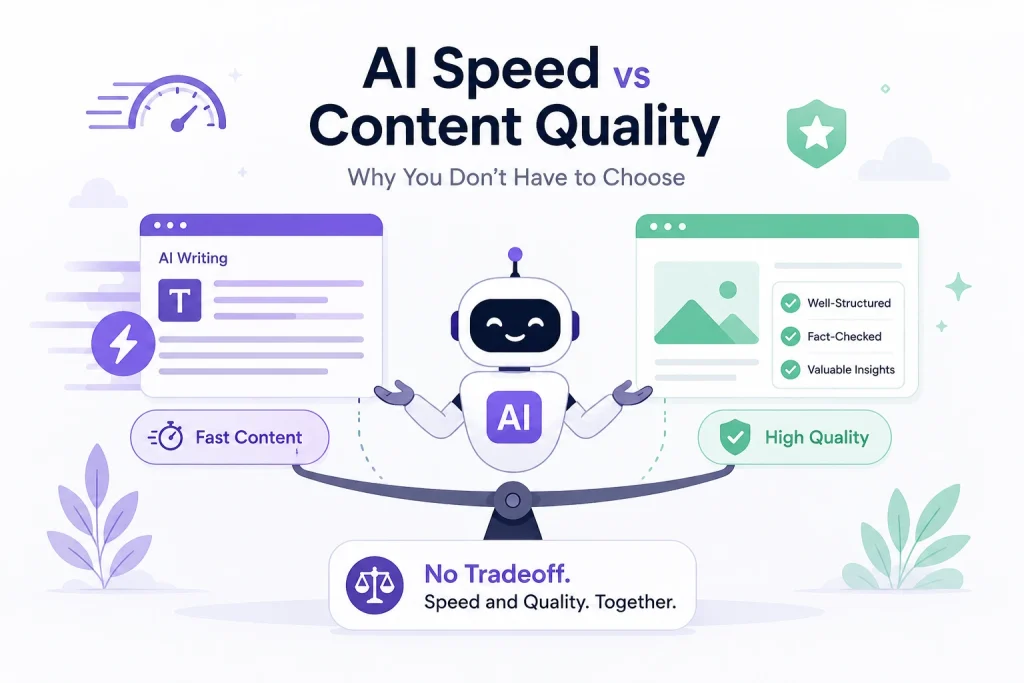
AI Speed vs Content Quality: Why You Don't Have to Choose
Everyone tells you the same thing about AI content: pick one, speed or quality. You can’t have both, they say. Fast content means shallow content. Good content means slow content. That’s not really true anymore.
Autoblogging has a reputation problem. Type it into Google, and you’ll find horror stories — thin articles, robotic sentences, facts that don’t check out. So the assumption sticks: if a tool writes fast, it must write badly. But the tradeoff isn’t baked into the tech. It’s baked into bad tools.
The real question isn’t whether AI can write fast. It already does. The question is whether it can write fast and still sound like something a person would actually want to read. That gap — between speed and substance — is where most autoblogging tools fall short, and it’s exactly what this article breaks down.
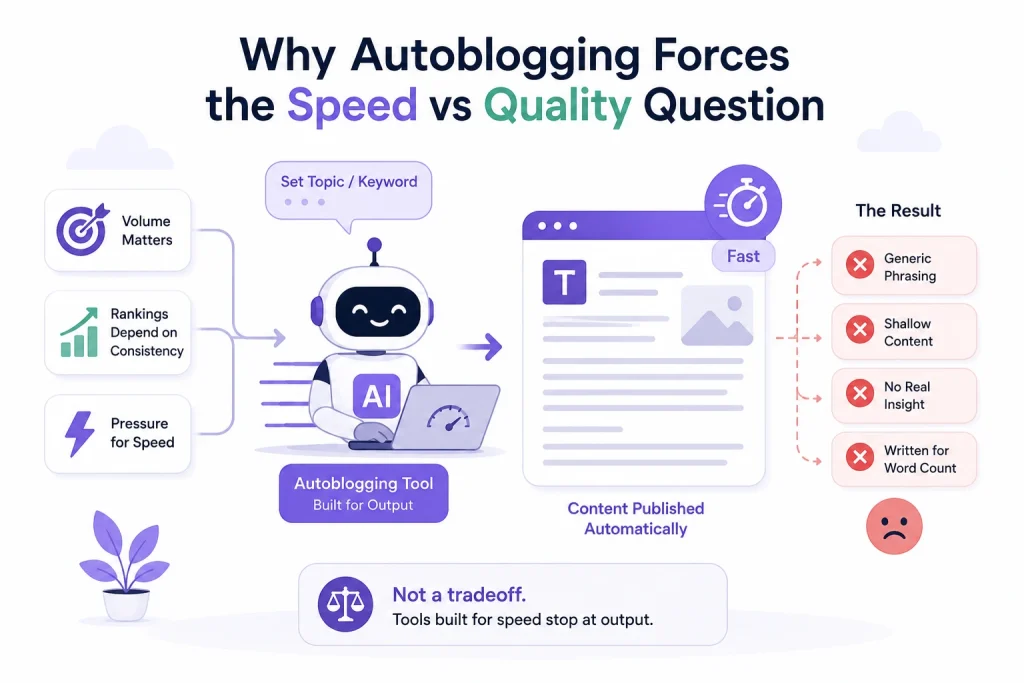
Why Autoblogging Forces the Speed vs Quality Question
Autoblogging is exactly what it sounds like — AI writes and publishes blog content with little to no manual work on your end. Set a topic, sometimes a keyword, and the tool takes it from there.
The appeal is obvious. Content marketing runs on volume. Search engines reward sites that publish consistently. Falling behind on output means falling behind in rankings, and that pressure pushes teams toward anything that promises speed.
That’s where the trouble starts. Most autoblogging tools were built to solve one problem: output. Not accuracy. Not tone. Not whether the article actually says anything useful. So the content comes out fast, technically finished, and often forgettable — generic phrasing, shallow takes, sentences that read like they were written to hit a word count instead of answer a question.
This is why autoblogging gets blamed for killing quality. Not because speed and quality are naturally at odds, but because the tools built for speed usually stop there.
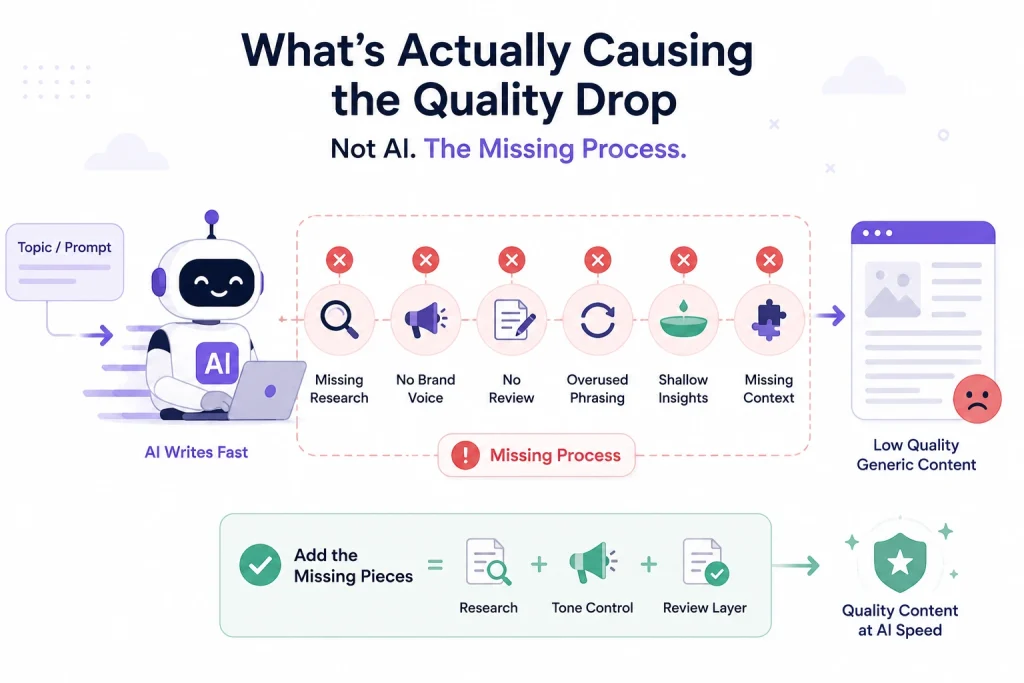
What's Actually Causing the Quality Drop (Not Just "AI Is the Problem")
Blaming AI for bad content misses what’s really going on. The model isn’t the weak link — the setup around it is. Most autoblogging tools were built to hit one goal: output. Nobody asked them to check facts, match a brand’s voice, or read back what they wrote. So they don’t.
That gap is showing up at scale. A March 2026 Gartner survey found that nearly half of U.S. consumers believe generative AI has made available content worse, with skepticism running even higher among Gen Z and millennial audiences. The issue isn’t AI adoption itself — it’s that AI is increasing the volume of content people encounter without necessarily increasing its value, according to Gartner analyst Kate Muhl.
Why Autoblogging Quality Drops
- No research grounding — content is generated straight from a prompt with nothing to fact-check it against
- No brand voice settings — every article sounds the same, regardless of the site
- No editing pass — whatever the first draft says is what goes live
- Overused phrasing — the same transitions and sentence patterns repeat across articles
- Shallow takes — answers cover the topic without adding real insight
- No context awareness — content ignores what’s already published on the site, leading to repetition or gaps
None of this is a limitation of AI itself. It’s a missing process. Add research, tone control, and a review layer back in, and speed stops costing you quality.
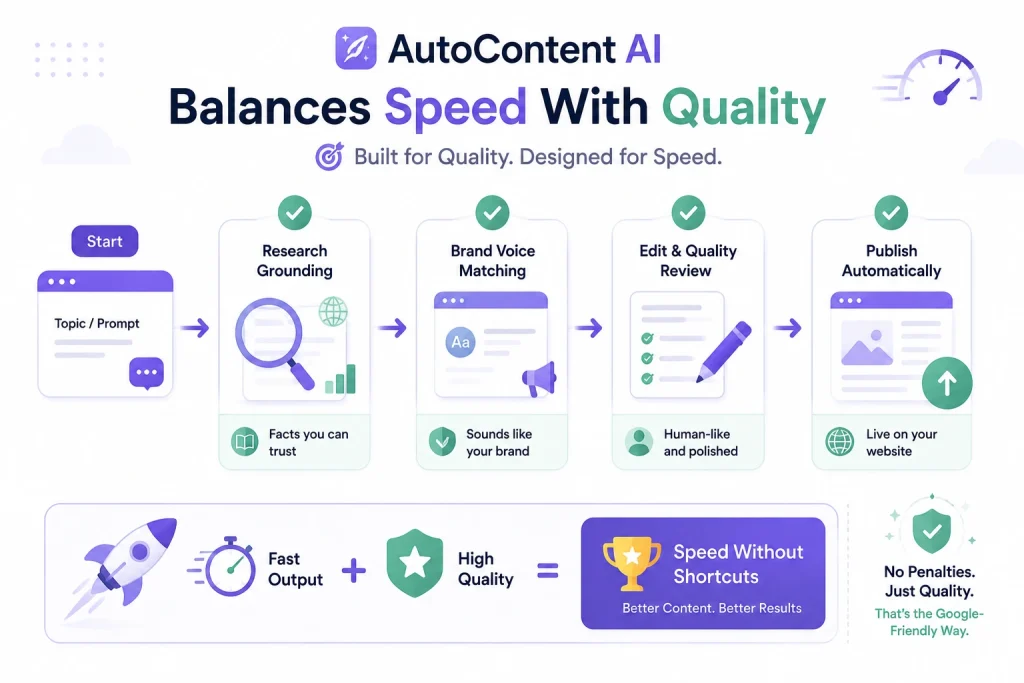
How AutoContent AI Balances Speed With Quality
This is exactly the gap AutoContent AI was built to close. Instead of generating from a bare prompt and stopping there, it builds in the steps most autoblogging tools skip — research grounding so claims hold up, brand voice settings so content sounds like your site instead of a generic template, and an editing pass before anything publishes.
That structure matters more than it might seem. Independent analysis from Ahrefs, covering 600,000 pages, found essentially no relationship between AI-generated content and search ranking penalties — Google doesn’t penalize content for being AI-written, it penalizes content for being low-quality. AutoContent AI is built around that exact target: not tricking search engines, just not giving them a reason to care that AI was involved.
Speed Without the Shortcuts
The output is still fast — that’s the whole point of autoblogging. But speed here means the tool moves quickly through a process built for quality, not that it skipped the process to save time.
That’s the difference between a tool that publishes content and one that publishes content worth reading. Same pace, none of the shortcuts that usually cause the quality drop.
WordPress AI Content Generator vs. Automatic Blog Post Generator — Where AutoContent AI Fits
WordPress AI Content Generator
- Writes the draft based on your topic or prompt
- Stops once the content is generated — no formatting or publishing included
- You copy the text over, format it, add images, and hit publish yourself
- Works well when you just need help getting past a blank page
Automatic Blog Post Generator
- Writes the content and formats it for the site automatically
- Publishes directly to WordPress without manual steps in between
- Runs on a schedule if set up that way, with no ongoing hands-on work
- Fits when the goal is real autoblogging — content going live without you touching WordPress each time
AutoContent AI covers both ends. It works as a content generator when you want a draft to review before publishing, and as a full automatic blog post generator when you want it to write, format, and publish on its own. Same tool, either workflow, so the choice comes down to how much control you want to keep in the loop.
AutoContent AI Beyond WordPress — Shopify AI Blogging and Other Platforms
The speed-without-shortcuts approach isn’t limited to WordPress. Store owners running Shopify face the same pressure — regular content keeps a store visible in search, but most Shopify AI blogging tools have the same gaps as their WordPress counterparts: no research grounding, no voice matching, no editing pass.
AutoContent AI applies the same process regardless of platform. Research-backed drafts, brand tone carried through every post, and an editing layer before anything publishes — whether that’s a WordPress site or a Shopify store. The platform changes; the standard for what counts as “good enough to publish” doesn’t.
That consistency is really the point of this whole article. Speed and quality were never actually opposites — they just require a tool built to handle both, on whatever platform you’re running.
Conclusion
Speed and quality were never actually opposites — that was always a limitation of the tools, not a rule of AI content. The data backs this up: Ahrefs’ analysis of 600,000 pages found close to zero correlation between AI-generated content and search ranking penalties, which means the “AI content is automatically worse” assumption doesn’t hold up under scrutiny. What actually drags quality down is missing research, missing brand voice, and missing editing — not the speed itself.
AutoContent AI closes that gap by building all three back into the autoblogging process. Every article starts with research-grounded drafts, carries a consistent brand voice, and passes through an editing layer before it publishes — on WordPress, on Shopify, or any other platform. The result is content that moves at autoblogging speed without asking you to accept autoblogging’s usual quality problems.
The short answer: autoblogging doesn’t have to mean a tradeoff. With the right process built in, speed and quality aren’t competing goals — they’re just two outcomes of the same well-built tool.
FAQs
Does autoblogging hurt SEO rankings?
Not inherently. Ahrefs’ analysis of 600,000 pages found essentially no correlation between AI-generated content and ranking penalties. What hurts rankings is low-quality content, whether it’s written by AI or a person — Google’s own guidance focuses on content quality signals, not who or what wrote it.
Can AI-generated content pass as human-written?
It depends on the process behind it. Content generated straight from a prompt, with no editing pass or voice matching, usually reads as generic AI writing. Tools that add research grounding, brand voice, and editing — like AutoContent AI — close most of that gap.
How much editing does autoblogged content still need?
Less than people expect, if the tool includes an editing pass by default. Tools without one need heavy manual cleanup every time. Tools built with research grounding and voice matching still benefit from a quick human review, but not a full rewrite.
Is autoblogging safe for niche-expert or high-stakes topics?
It depends on the research grounding behind the content. Topics that require accuracy — health, finance, legal — need a tool that pulls from real sources and allows human review before publishing, not one that generates and publishes blind.
How is AutoContent AI different from a basic AI content generator?
A basic generator writes a draft and stops there. AutoContent AI (Powered by Pordix)adds research grounding, brand voice consistency, and an editing pass, then can publish directly to WordPress or Shopify — covering the full pipeline instead of just the first draft.