
Best CMS for SEO: Why Your Platform Is Only the Beginning
Choosing the right CMS often feels like the first big decision when building an online business. The platform you pick shapes how easily you publish content, optimize pages, manage your site, and scale as your audience grows. A good CMS makes SEO simpler by giving you better control over things like metadata, structure, and content management.
But over time, one thing becomes clear: a CMS is only the foundation. It’s not the whole growth system.
Many businesses invest in better platforms, SEO plugins, and technical upgrades, yet still struggle with the same problem — creating and maintaining valuable content consistently. That’s because modern SEO isn’t just about where your content lives anymore. It’s about how efficiently you can research, create, optimize, update, and distribute content that matches what people are actually searching for.
The best CMS for SEO in 2026 isn’t the one with the most features. It’s the one that works alongside a smarter content workflow — one that helps businesses move faster, stay consistent, and build long-term visibility. As search keeps evolving with AI-powered experiences, the businesses that adapt won’t just rely on better websites. They’ll build better systems behind them.
In this guide, we’ll break down what actually makes a CMS SEO-friendly, why traditional content workflows are struggling to scale, and how AI-powered content systems are shaping the future of SEO.
Why Choosing a CMS Is Only the First Step Toward SEO Growth
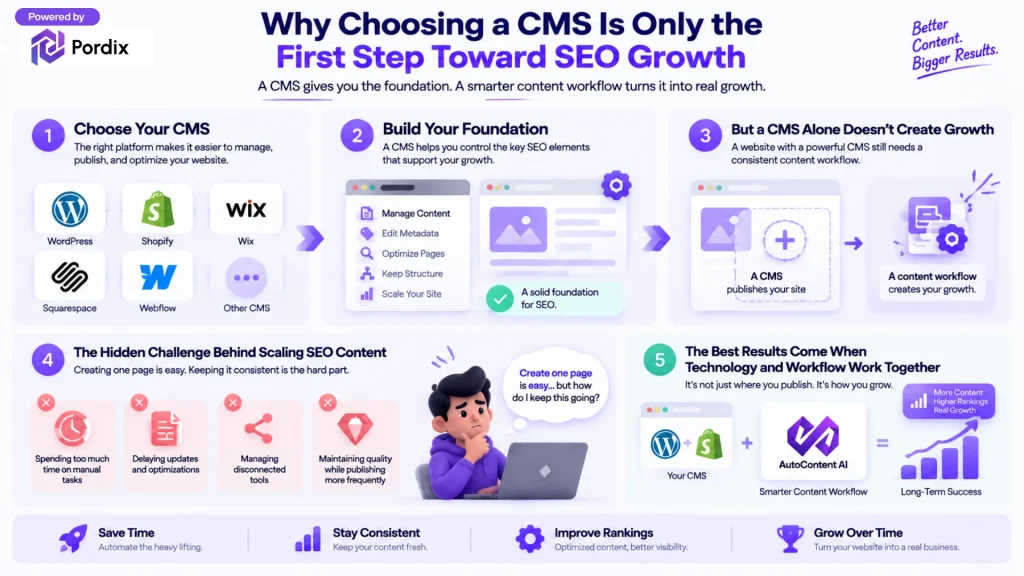
Choosing a CMS is often seen as the first major SEO decision. The right platform can make it easier to manage content, update important SEO elements, and keep your website organized as it grows.
But a CMS alone does not create growth. It only creates the foundation.
As websites expand, the real challenge becomes maintaining consistency — publishing valuable content, improving existing pages, adapting to search changes, and keeping everything optimized without slowing down. This is where many businesses realize that SEO is not just about having the right platform. It is about having a workflow that allows the platform to work at its full potential.
A website can have a powerful CMS, but without an efficient content process behind it, growth becomes harder to sustain.
The Hidden Challenge Behind Scaling SEO Content
Creating one optimized page is easy. Creating, updating, and managing content consistently over months and years is where the real work begins.
Businesses often struggle with:
- Spending too much time on manual content tasks
- Delaying updates and optimizations
- Managing disconnected tools
- Maintaining quality while publishing more frequently
The best results come when technology and workflow work together. Because in modern SEO, the advantage is not only having a place to publish content — it is having a system that helps you grow.
What Actually Makes a CMS SEO-Friendly?
A good CMS does more than help you publish contents. It gives you the control and flexibility to keep improving your website as search engines, users, and business goals change.
The most SEO-friendly CMS platforms aren’t necessarily the ones with the most features. They’re the ones that remove unnecessary barriers and make optimization easier over time.
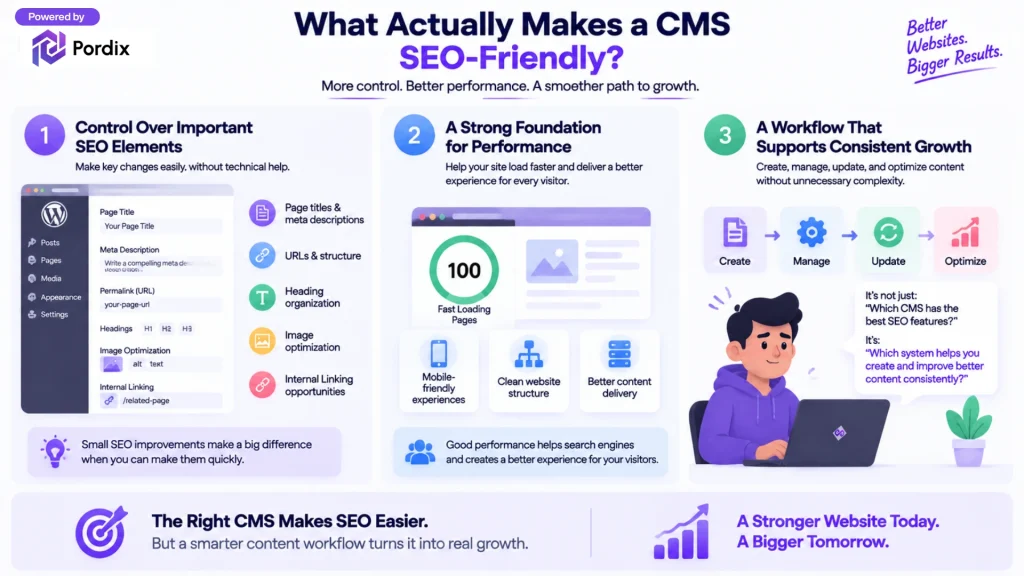
Control Over Important SEO Elements
Small SEO improvements often make a big difference, but they get harder when every change needs technical help.
An SEO-friendly CMS should make it simple to manage key elements like:
- Page titles and meta descriptions
- URLs and website structure
- Heading organization
- Image optimization
- Internal linking opportunities
When businesses can make these changes quickly, they can respond faster to new opportunities and shifting search behavior.
A Strong Foundation for Performance
A website can have great content, but slow performance still hurts the overall user experience.
A capable CMS should support:
- Faster page loading
- Mobile-friendly experiences
- Clean website structure
- Better content delivery
Because SEO isn’t only about helping search engines understand your content — it’s also about creating a better experience for the people visiting your site.
A Workflow That Supports Consistent Growth
The best CMS for SEO isn’t just the one that works today. It’s the one that can support your growth tomorrow. As content demands increase, businesses need smoother ways to create, manage, update, and optimize pages without unnecessary complexity. This is where the conversation around CMS starts to change.
The question is no longer just: “Which CMS has the best SEO features?”
It becomes:
“Which system helps you create and improve better content consistently?”
Why Traditional CMS Workflows Are Changing in the AI Era
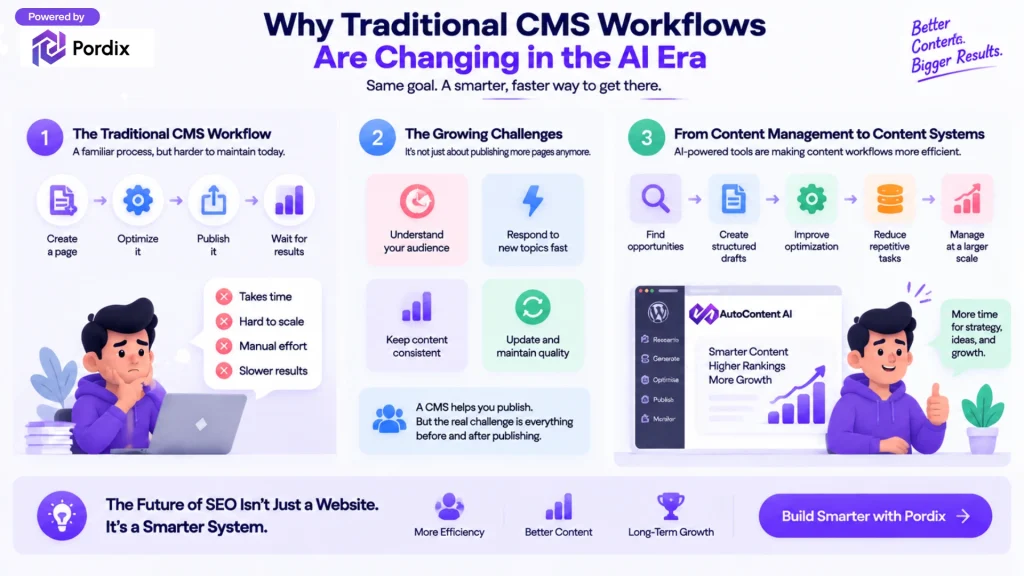
For years, building a website followed a familiar process:
Create a page → Optimize it → Publish it → Wait for results.
But as search keeps evolving, that process is getting harder to maintain. Businesses aren’t just competing on how many pages they publish anymore. They’re competing on how well they understand their audience, how fast they can respond to new topics, and how consistently they can improve their content.
A CMS helps organize and publish information, but the growing challenge is everything that happens before and after publishing. Researching ideas, creating helpful content, optimizing for search intent, updating older pages, and maintaining quality — all of it takes time and effort.
From Content Management to Content Systems
The future of SEO is moving beyond simply managing content. It’s about building systems that make content creation and optimization more efficient.
Instead of relying on fully manual workflows, businesses are starting to use AI-powered tools to support different stages of the process:
- Finding content opportunities
- Creating structured drafts
- Improving optimization
- Reducing repetitive tasks
- Managing content at a larger scale
The goal isn’t to replace human creativity. It’s to give entrepreneurs and teams more time to focus on strategy, ideas, and growth. Because the businesses that succeed in the next phase of SEO won’t just be the ones with a website. They’ll be the ones with a smarter system behind it.
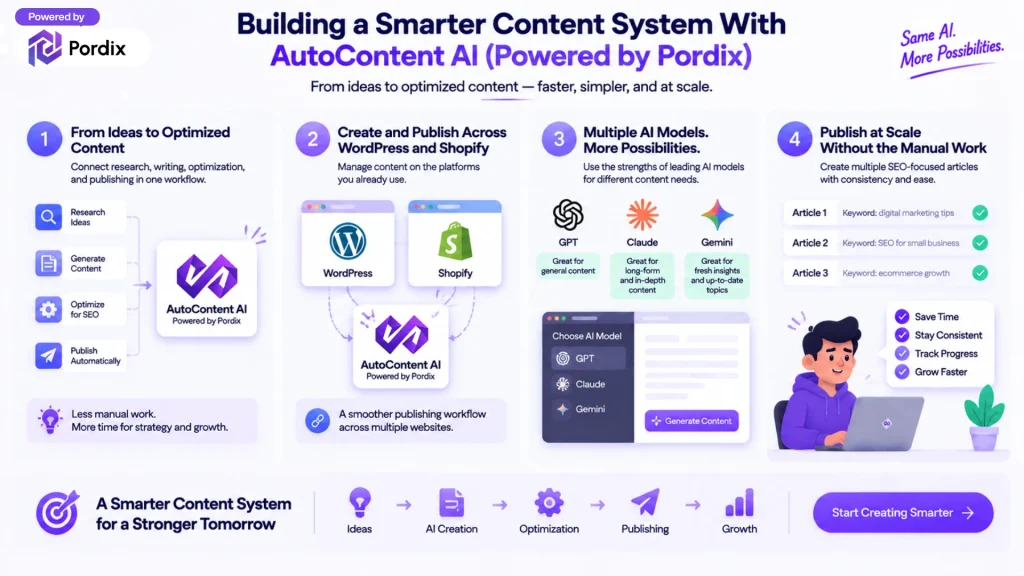
Building a Smarter Content System With AutoContent AI (Powered by Pordix)
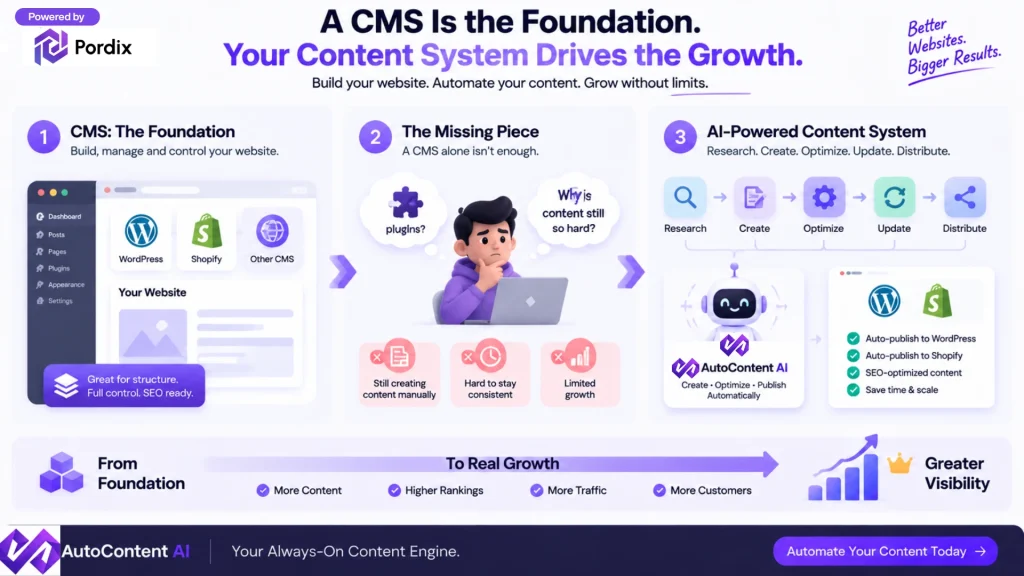
A CMS gives businesses a place to manage and publish content. But as content demands grow, the real advantage comes from having a system that helps turn ideas into optimized content faster.
This is where AI-powered content workflows are changing how businesses approach SEO. AutoContent AI, powered by Pordix, helps simplify the content creation process by connecting research, writing, optimization, and publishing into a more efficient workflow.
Instead of spending hours managing repetitive tasks manually, businesses can use AI to support content production while keeping their focus on strategy, creativity, and growth.
Creating and Publishing Content Across WordPress and Shopify
Modern businesses often manage content across multiple platforms, which can make publishing workflows more complicated.
AutoContent AI helps bridge that gap by supporting integrations with platforms like WordPress and Shopify, allowing businesses to create and manage content within the systems they already use.
This creates a smoother path from content planning to publishing without constantly moving between disconnected tools.
Combining Multiple AI Models for More Flexible Content Creation
One of the biggest changes in AI content creation is that businesses are no longer limited to a single AI model. Different AI systems bring different strengths, and combining them creates a more flexible approach to content production.
With AutoContent AI, businesses can leverage advanced AI models such as GPT, Claude, and Gemini to support different content needs, whether the priority is quality, speed, or workflow efficiency.
Publishing at Scale Without the Manual Work
Creating content consistently is one of the biggest challenges businesses face as they grow.
AutoContent AI’s bulk generation capabilities help simplify this process by allowing users to create multiple SEO-focused articles while maintaining formatting, structure, and publishing efficiency.
This helps businesses:
- Reduce repetitive content tasks and save valuable time
- Maintain a consistent publishing workflow
- Manage larger content projects without unnecessary complexity
- Keep better visibility over generated content through activity tracking
- Expand content operations across multiple websites more efficiently
The future of SEO will not belong to businesses that create more content. It will belong to those that build smarter systems around content creation.
The Future of SEO Belongs to Smarter Content Systems
SEO has always rewarded businesses that understand change. The strategies that worked years ago continue to evolve as search engines become better at understanding content, user intent, and the experiences behind every search.
Today, the challenge is no longer simply creating more pages or adding more keywords. It is building a process that allows businesses to consistently create useful content, improve existing information, and adapt as search behavior changes.
A CMS provides the foundation. AI provides new possibilities. But the real advantage comes from combining technology with a smarter workflow. Businesses that succeed in the future will not necessarily be the ones with the largest teams or the most complicated technology stacks. They will be the ones that create systems allowing them to move faster, make better decisions, and focus their time on growth.
The next phase of SEO is not about replacing human creativity with automation. It is about using automation to give creativity more room to succeed.
Frequently Asked Questions
Q1. What is the best CMS for SEO in 2026?
The best CMS for SEO in 2026 depends on your website goals and workflow. WordPress remains a popular choice because of its flexibility and SEO ecosystem, while HubSpot CMS offers built-in marketing and optimization features. Beyond the CMS itself, AutoContent AI (powered by Pordix) helps automate SEO content workflows across platforms like WordPress and Shopify.
Q2. Does the CMS platform affect SEO rankings?
Yes, a CMS can influence SEO performance by affecting factors such as website speed, mobile experience, URL structure, metadata control, and how easily content can be optimized. However, a CMS alone does not guarantee rankings. Content quality, user experience, technical SEO, and consistent optimization all play important roles.
Q3. What features should an SEO-friendly CMS have?
An SEO-friendly CMS should make it easy to manage important optimization elements such as page titles, meta descriptions, URLs, headings, image settings, and structured data. It should also support fast performance, mobile optimization, content organization, and integrations that help improve the overall SEO workflow.
Q4. Can AI tools help improve SEO content creation?
Yes, AI tools can help improve SEO content workflows by assisting with research, content planning, drafting, optimization, and publishing tasks. When combined with human expertise and proper SEO strategy, AI can help businesses create content more efficiently while maintaining quality and relevance.
Q5. Can AI-generated content rank on Google?
AI-generated content can rank when it provides useful, accurate, and valuable information that satisfies user intent. Search engines focus on content quality, originality, and usefulness rather than whether content was created with AI or manually. The best results come from combining AI assistance with human review and strategic optimization.
Q6. How can businesses automate SEO content workflows?
Businesses can automate SEO content workflows by connecting research, content creation, optimization, and publishing processes through AI-powered systems. Tools like AutoContent AI (powered by Pordix) help streamline these tasks by supporting content generation and publishing workflows across platforms such as WordPress and Shopify.