
Does Google Penalize AI Content? What the 2026 Updates Actually Say
Does Google penalize AI content? No. Google does not penalize content because AI helped write it. Its spam policies target pages made mainly to manipulate rankings, such as mass-produced, low-value pages, regardless of how they were made. AI-assisted pages that are edited, fact-checked, and useful are within the rules.
You publish a batch of AI-assisted articles. A few weeks later Google rolls out an update, your traffic wobbles, and one question takes over: was it the AI?
The search landscape in 2026 gave people plenty of reasons to ask. Google ran four spam updates and two broad core updates, and on October 1 it rewrote part of its guidance on AI content. So let’s separate what Google has actually said from what the internet is guessing. What changed in 2026 is how firmly Google enforces those rules and how much review it expects, not the rules themselves.
A Quick Summary of Google’s Policy on AI-Generated Content
- Google’s position has held since February 2023. The policy that matters is scaled content abuse, added in March 2024.
- None of the 2026 updates were announced as an AI update.
- On October 1, 2026, Google called manual fact-checking of AI output “critical,” including titles, meta descriptions, structured data, and alt text.
- Ranking data shows a gradient, not a cliff: AI-assisted pages rank, and fully AI pages are rare at the very top.
One disclosure before we dig in. We build automation tools at Pordix, including AutoContent AI, so we have a stake in this question. That is why we checked each claim below against Google’s own documentation and the original studies, and why we point out where the evidence is thin.
Google Policy on AI-Generated Content: What Google Has Said
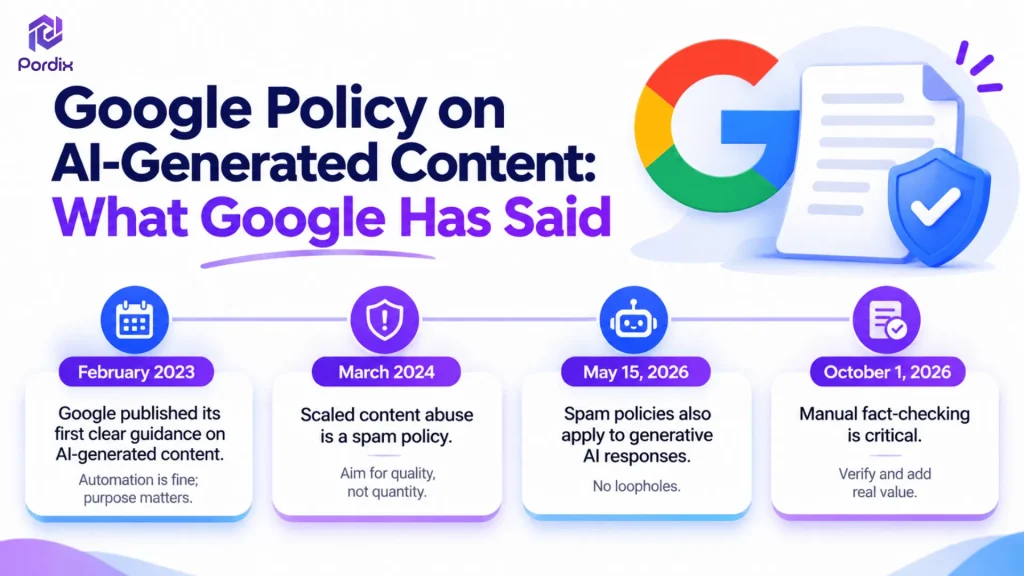
Google has been remarkably consistent regarding the Google policy on AI-generated content. Here is the verified record:
- February 2023: Google published its first clear guidance on AI-generated content. Automation is fine in publishing; using it mainly to manipulate rankings is not. The test is purpose, not tool.
- March 2024: Google named scaled content abuse as a spam policy: producing many pages mainly to rank rather than to help people, whether by automation, humans, or both. Google said scaled production had grown too sophisticated to judge by method alone. It expected 40% less low-quality, unoriginal content in results and reported 45% once the rollout finished on April 19.
- May 15, 2026: Google clarified that its spam policies also apply to generative AI responses, including AI Overviews and AI Mode. Old manipulation tricks don’t get a pass in new places.
- October 1, 2026: Google updated its generative AI guide to call manual fact-checking critical. We unpack that below.
What Google’s guidance means for publishers
Three ideas sit under all of it. Don’t create pages mainly to rank. Check your facts and add real value. Tell readers how you used automation when they would want to know. Two footnotes. Google’s quality rater guidelines describe scaled content abuse as lots of content made with little effort or originality and no editing, and they name generative AI as one tool for it.
However, Google says rater scores don’t directly influence rankings. And if you’re waiting on a “helpful content update,” there isn’t a separate one anymore. Since March 2024, that system has been part of Google’s core ranking systems.
Does Google Penalize AI Content 2026? The Update Timeline
Notice what’s missing: no update was labeled an AI update, and Google didn’t name AI as a target. The June exclusions come from Google’s answer to Search Engine Roundtable, and some outlets note that Google published no official target list, so treat them as reported, not official.
How to read your own traffic: A spam update tunes how Google catches policy violations, so check affected pages against the spam policies first. A core update is a broad quality reassessment, so the cause is wider and slower to pin down. Google’s guidance says to wait a full week after a core update finishes, then compare that week with the week before the rollout began.
So will Google penalize AI content? Google acted on spam. Some of that spam was made with AI. That is not the same as penalizing AI, and timing alone can’t prove otherwise.
What Gets Hit and What Is Fine
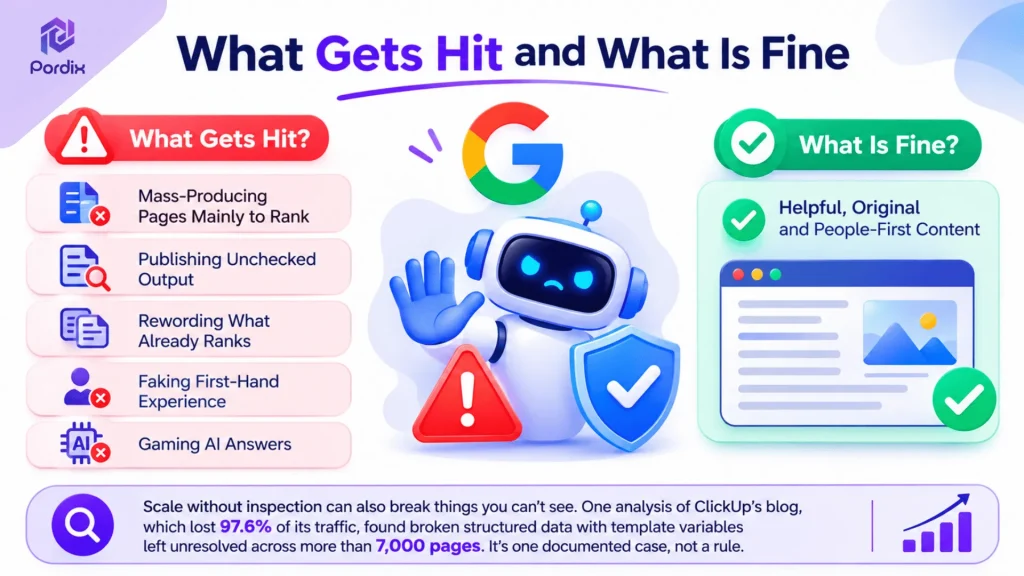
When publishers ask whether Google penalizes AI-generated content, they often confuse tool usage with quality failures. Google doesn’t sort pages into “AI” and “human.” It sorts them into “made to help readers” and “made to game search.” These habits cause the trouble:
- Mass-producing pages mainly to rank: Hundreds of near-identical pages built around keywords are the classic scaled content abuse pattern.
- Publishing unchecked output: Language models predict likely words; they don’t look facts up. Errors read fluently.
- Rewording what already ranks: If your page adds nothing new to the results, it has no reason to exist.
- Faking first-hand experience: “We tested this” when nobody did is a trust problem, whoever types it.
- Gaming AI answers: Since May 2026, manipulating AI Overviews or AI Mode with biased listicles or fake mentions falls under the same spam policies.
Scale without inspection can also break things you can’t see. One analysis of ClickUp’s blog, which lost 97.6% of its traffic, found broken structured data with template variables left unresolved across more than 7,000 pages. It’s one documented case, not a rule, but it shows why metadata needs a human read.
How to diagnose a traffic drop
If your traffic drops, first work out whether it’s a manual action or an algorithmic demotion. Open the Manual Actions report in Search Console. A manual action shows a notice (for example, “major spam problems”); you fix the issue and then file a reconsideration request. If the report is empty, the drop is algorithmic. There’s no notice, a reconsideration request won’t help, and recovery comes from improving the content and waiting for later crawls and updates.
Here’s a quick gut check. Take the AI out of the picture. Would the page still have something worth reading? If yes, you’re on the safe side. If not, no tool will save it.
What the Ranking Data Shows
Four studies give a rough picture of how machine-assisted text performs. All rely on AI detectors, which estimate rather than prove, so read them as directional:
- Semrush (December 2024): Looked at 20,000 blog articles from top-20 results. About 8% were flagged as likely AI, and AI-flagged and human-written articles reached the top 10 at nearly the same rate: 57% versus 58%.
- Ahrefs (July 2025): Studied 600,000 pages from the top 20 for 100,000 keywords. 86.5% contained some AI, 4.6% were pure AI, and 81.9% were a mix. The correlation with ranking position was near zero.
- Ahrefs (July 2026): Pulled about a million top-10 pages from 100,000 June 2026 results; roughly 150,000 had enough text to score. Among top-3 pages, 54.7% had under 20% AI and 82.2% had under 50%. Nine percent had 80% or more AI, and 5.3% were fully AI.
- Originality.ai (August 2026): Checked 1,687 top-20 results across 500 informational queries and flagged 19.1% as likely AI, down from 21.6% in July. Its sample of 2026 web articles ran 40–47%.
They don’t actually conflict. Ahrefs’ 2025 figure counts any AI use, even a little. Originality.ai flags pages that look mostly AI. And the open web is far more AI-heavy than the results Google chooses to show.
What the 2026 data suggests about rankings
The 2026 Ahrefs study is the most useful of the four, because it shows a gentle gradient across positions rather than a cutoff. At position 1, 8.4% of pages had 80% or more AI content, against 11.7% at position 10, and the average AI level crept from 27.1% to 30.9%. Indexing followed the same slope: pages with low AI content were indexed at 49.28%, against 40.35% for very high AI content. Low and moderate AI pages earned two to three times the impressions of high and very high ones, and the heavily AI groups showed no sudden drop over time.
Ahrefs is careful about what this means. Its detector isn’t how Google works, ranking samples only include URLs that already succeeded, and AI-heavy sites may be newer or weaker. Its reading is that AI use tends to travel with lower quality, and quality is what Google scores.
How to Publish AI Content Without Risking a Penalty
Following a disciplined, human-reviewed workflow ensures your publishing strategy remains completely safe:
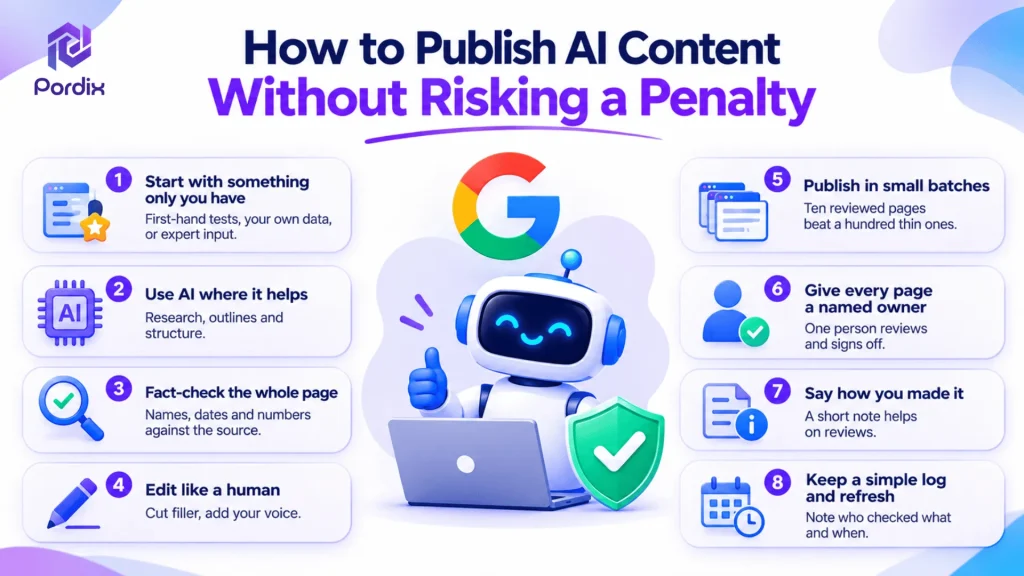
- Start with something only you have: First-hand tests, your own data, customer examples, or expert input. AI is good at summarizing what already exists, and the results already have that.
- Use AI where it helps: Research, outlines, and structure are what Google itself says AI is useful for, as long as the ideas and experience behind the page are real.
- Fact-check the whole page, metadata included: Names, dates, and numbers against the source, then titles, meta descriptions, schema, and alt text.
- Edit like a human: Cut filler, answer the main question early, add links and visuals, and put your own voice back in.
- Publish in small batches: Ten reviewed pages beat a hundred thin ones, and volume without value is exactly what scaled content abuse describes.
- Give every page a named owner: One person reviews it and signs off.
- Say how you made it where it matters: Google doesn’t ask for a label on every page, but a short note helps on reviews, advice, and data-heavy posts.
- Keep a simple log and refresh: Note who checked what and when. Google doesn’t require it, but it proves your process, and you can revisit key pages when facts change.
Conclusion
Google doesn’t penalize AI content for being AI content. It acts when pages exist mainly to rank, when they’re mass-produced, or when they carry unchecked claims. Four spam updates, two core updates, and a firmer October guide all point the same way: Google wants proof that a person cared about the page.
The rule has barely moved since 2023. What moved is enforcement and the expectation of review. You can’t control the next update date. You can control whether your pages are checked, original, and useful, and that is the only preparation that holds up.
If AI-assisted content is part of your plan, take a look at AutoContent AI on Pordix, and keep the human review step in your process, whichever tool you use.
Frequently Asked Questions
Q1. Does Google Penalize AI-Generated Content, or Does It Only Penalize Spam and Manipulative Pages?
No. Google doesn’t penalize content for how it was made. It acts on spam policy violations such as scaled content abuse. Edited, fact-checked AI-assisted content that helps readers isn’t a violation.
Q2. Can Google Detect AI-Generated Content, and Does Detection Affect Search Rankings?
Google can watermark and identify text from its own Gemini models, but its guidance doesn’t ask you to pass a detector. It focuses on whether content is helpful and accurate. Third-party detectors only estimate and often err, so use them as signals.
Q3. Do Publishers Need to Disclose When They Use AI to Create or Edit Website Content?
Google doesn’t ask you to label every page. Its guidance says explaining how content was made is useful where readers might wonder. Be open when it matters, such as reviews, advice, and anything readers rely on.
Q4. Could Google Penalize AI-Generated Content in the Future as Its Search Policies Evolve?
No one outside Google can say. The policy has held since 2023, but enforcement has grown firmer, with four spam updates in 2026 and the October 1 fact-checking note. Pages that would pass a policy check today are safest.
Q5. Can AI-Assisted Content Rank Number One on Google Search Results?
Yes, but rarely when it’s unedited. Ahrefs found 5.3% of top-3 pages were fully AI, while position one had the lowest share of heavily AI pages. AI-assisted pages with human input do well, as Semrush’s 57% versus 58% top-10 split shows.