
Integrating Chatbots and Human Agents for Seamless Support
Your support inbox never really closes. Customers message at midnight, sales leads go quiet after hours, and your team can only be in so many places at once.
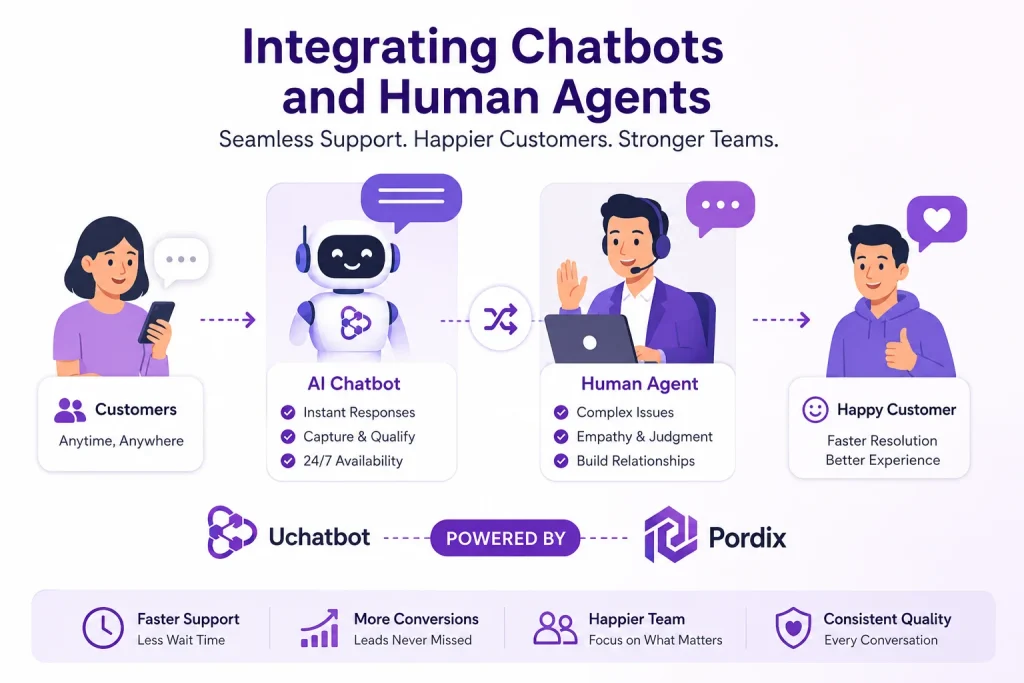
This is the gap chatbots and human teams are built to close together. The bot picks up the moment someone reaches out — answering questions, capturing details, keeping the conversation moving. The human steps in when the moment calls for real judgment or a bit of empathy a script can’t fake. That balance is the whole point of bringing chatbots and human teams together. It’s not about automating people out of the picture. It’s about freeing them up for the conversations that actually need a person.
Get this right, and support gets faster, leads stop slipping away, and your team stops burning out from repetitive work. Get it wrong, and customers feel like they’re talking to a wall.
This guide walks through how to build that balance — where to draw the line between bot and human, how it fuels growth, and what to avoid along the way.
How Chatbots and Human Agents Work Together?
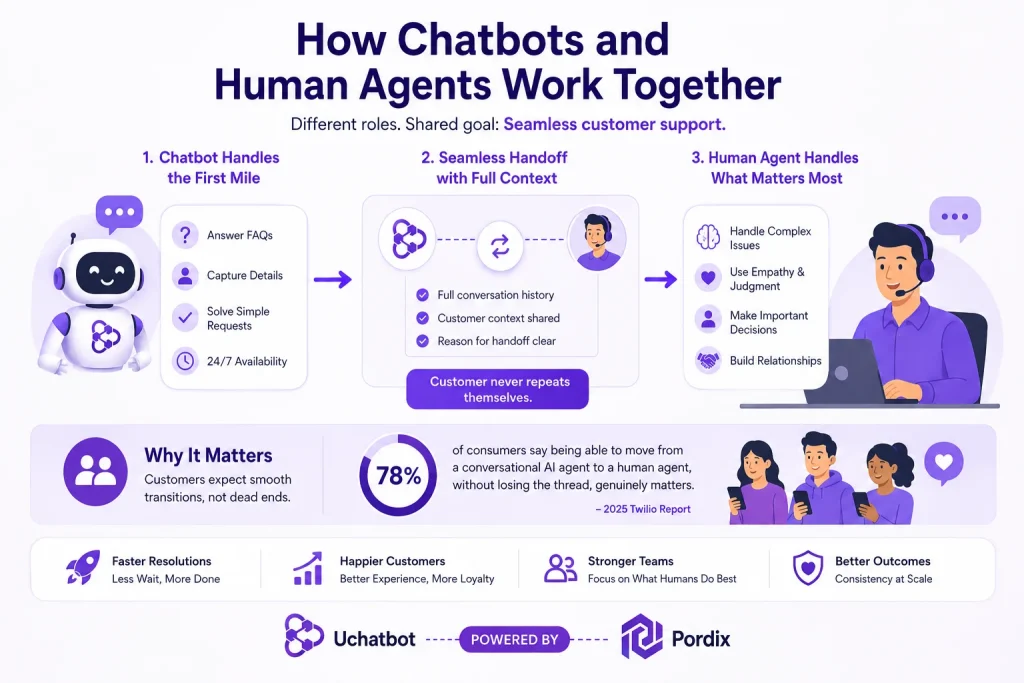
Chatbots and human teams aren’t competing for the same job. They’re splitting one job in half. The bot handles volume — FAQs, contact capture, simple requests, all resolved instantly and around the clock. The human agent handles nuance, stepping in when a conversation needs judgment, patience, or a decision the bot was never built to make.
None of that works without a smooth switch. When it happens cleanly, the customer never notices the transition — the human already has the full conversation, the context, and the reason they’re now involved. When it’s clumsy, the customer repeats themselves to someone who’s clearly starting from zero, and the goodwill from the fast bot response evaporates instantly. That switch is where most hybrid support setups actually succeed or fail. Not the bot’s intelligence. Not the human’s skill. Just whether the baton gets passed cleanly between them.
It’s not just an internal preference, either. A 2025 Twilio report found that 78% of consumers say being able to move from a conversational AI agent to a human agent, without losing the thread of the conversation, genuinely matters to them. Customers notice when this works, and they notice even more when it doesn’t.
Get that one moment right, and everything else in a chatbot-and-human workflow tends to hold together on its own.
Why This Matters for Lead Generation and Growth
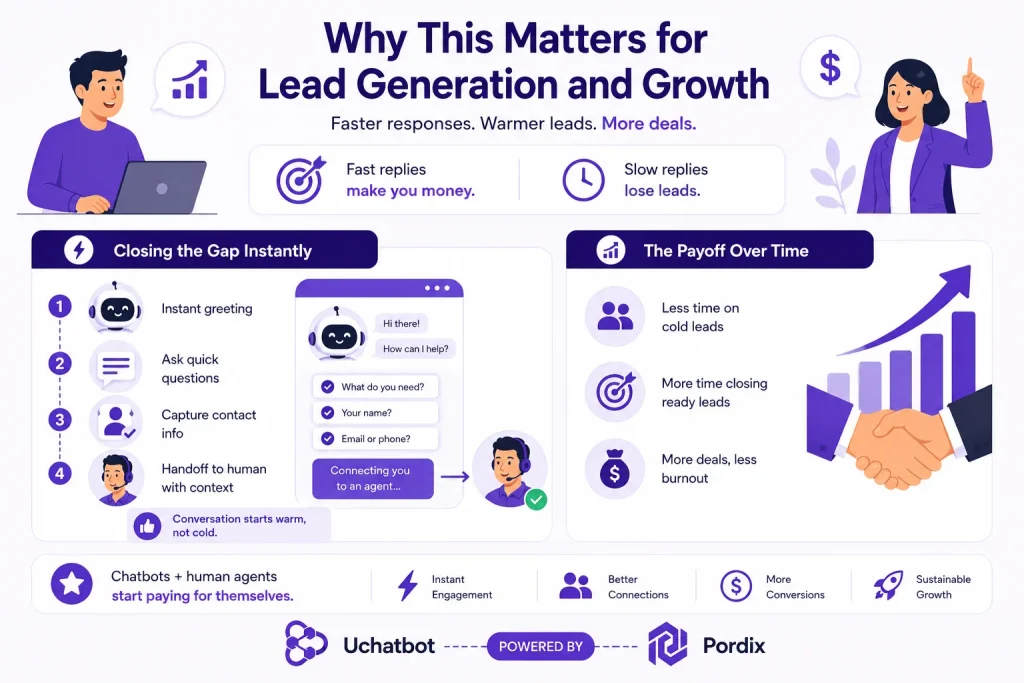
A quick reply doesn’t just make customers happy. It makes you money — the longer a lead waits, the more likely they are to lose interest and go somewhere else.
Closing the Gap Instantly
- Says hello the second someone lands on your site, no waiting around
- Asks a couple of quick questions to figure out what they need
- Grabs their contact info before they click away
- Passes the visitor over to a real human agent — one who already knows what they want, so the conversation starts warm instead of cold
The Payoff Over Time
- Your sales team spends less time hunting down leads that went cold.
- More time closing the ones that are actually ready to buy
- Do that for a few months, and you’re looking at more deals, less burnout, and growth that doesn’t need a bigger team to pull off.
This is the moment chatbots and human agents stop being just a support setup and start paying for themselves.
Bringing Chatbots and Human Agents Into an Enterprise Team
Rolling this out at a small business is one thing. Doing it across an enterprise with multiple departments, tools, and support tiers is a different challenge entirely.
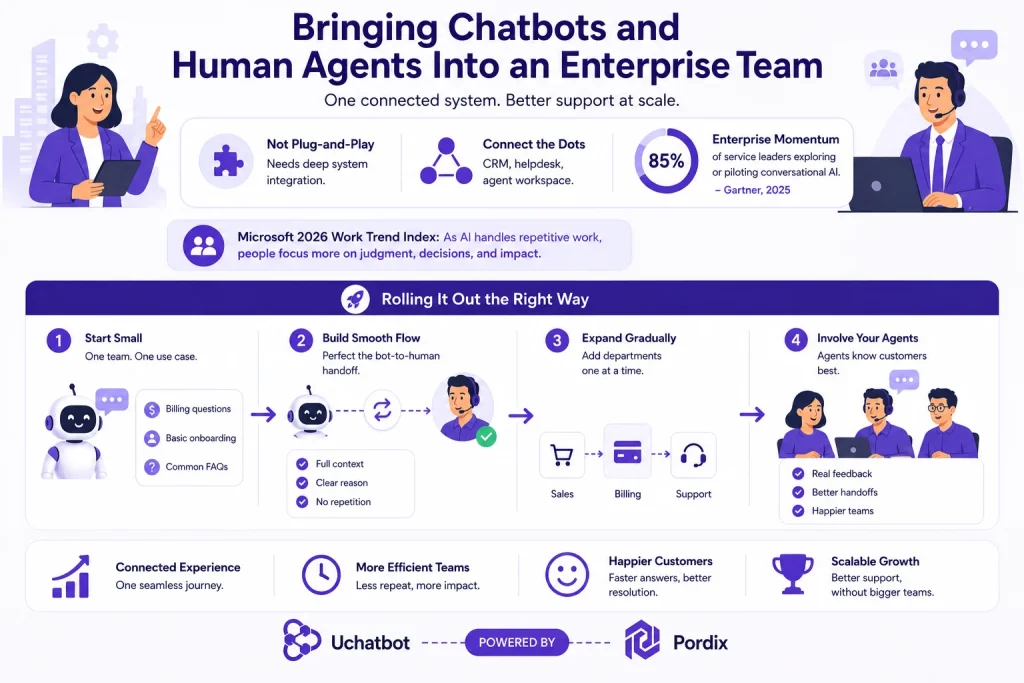
The biggest mistake companies make is treating enterprise chatbot integration like a plug-and-play add-on. It’s not. The bot needs to connect to your CRM, your helpdesk software, and whatever system your agents already live in every day. If it can’t pull up a customer’s order history or past tickets, it’s just guessing — and your human agents end up doing double the work to catch up.
This isn’t a niche concern anymore, either. Gartner has reported that 85% of customer service leaders were already exploring or piloting conversational AI as of 2025. Microsoft’s own 2026 Work Trend Index found something similar from the employee side. As AI takes over more repetitive execution work, people end up with more room to focus on judgment calls and decisions that actually need a person. That’s the exact shift a well-integrated chatbot should create for an enterprise support team.
Rolling It Out the Right Way
Start smaller than you think you need to. Pick one team or one type of request — say, billing questions or basic onboarding — and get the bot-to-human flow working smoothly there first. Once that’s solid, expand it to other departments one at a time.
The teams that get this right also loop in the actual agents early, not just IT. The people fielding these conversations every day know exactly where customers get stuck and exactly when a bot should step aside. Skip that input, and you’ll build a system that looks great on paper but frustrates the people using it daily.
Done well, this turns chatbots and human agents into one connected system instead of two tools bolted together.
Common Mistakes That Break the Chatbot-to-Human Switch
Most hybrid setups don’t fail because the bot is dumb or the human is slow. They fail because of a few avoidable mistakes that show up over and over.
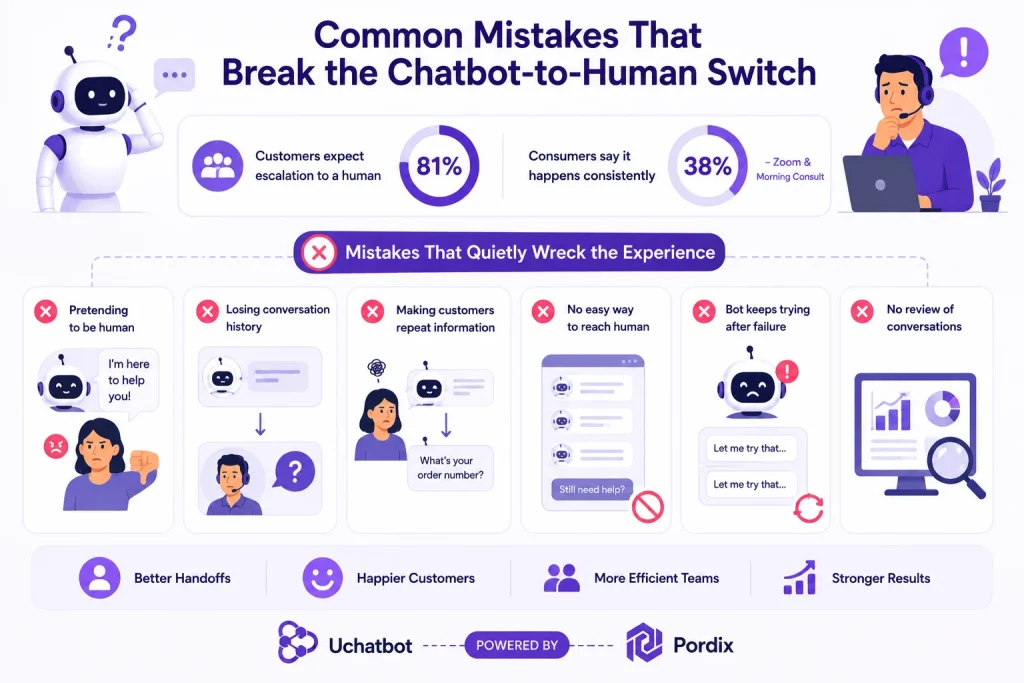
The biggest one: making the bot pretend it’s human. Customers can tell within a message or two, and once they feel tricked, trust drops fast. Being upfront that they’re talking to a bot actually builds more trust, not less.
This gap is bigger than most teams realize. Research from Zoom and Morning Consult found that 81% of consumers expect a chatbot to escalate to a human when needed, but only 38% say that actually happens consistently. That disconnect is exactly where customer experience quietly breaks down, and it’s where most of the mistakes below come from.
Mistakes That Quietly Wreck the Experience
- Making the bot pretend to be human instead of just owning it
- Losing the conversation history when a human agent takes over
- Making the customer repeat what they already told the bot
- No easy way to reach a person — customers stuck in a bot loop with no exit
- Letting the bot keep trying something it’s already failed at twice
- No one reviewing bot conversations to see where it’s actually struggling
Fix these and the whole system runs a lot smoother — for the customer and for your team.
The Best AI Chatbot for 2026
By now, the question isn’t whether to use a chatbot. It’s which one actually works well with your team instead of getting in their way.
A lot of tools promise smart automation but fall short on the part that matters most here — switching cleanly to a human when the moment calls for it. If you’re looking for the best AI chatbot for 2026, that switch quality should be the first thing you test, not an afterthought.
What to Check Before You Choose
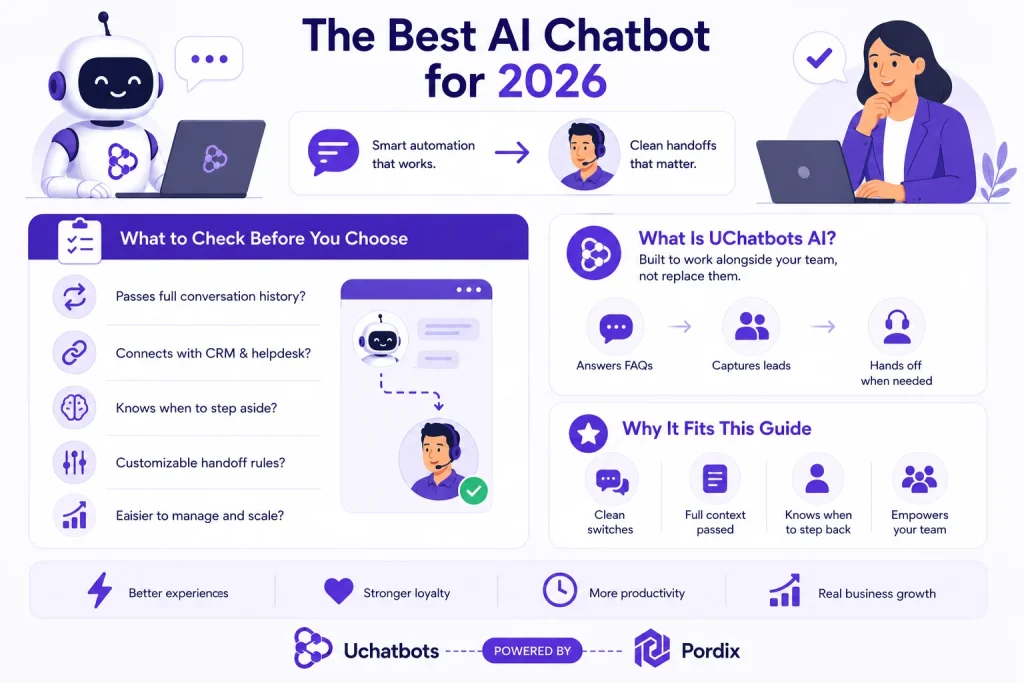
- Does it pass full conversation history to the human agent, or start from scratch?
- Can it connect to your CRM and helpdesk without months of setup?
- Does it know when to step aside instead of forcing a bad answer?
- Can your team customize how and when it switches to a human?
- Does it actually get easier to manage as your team grows?
What Is UChatbots AI
UChatbots AI, powered by Pordix, is a chatbot built around one core idea — working alongside your team, not replacing the human part of the conversation. It handles the repetitive front-line work like answering FAQs and capturing leads, then hands things off cleanly the moment a real person needs to step in.
Why It Fits This Guide
Everything this article has argued for — clean switches, full context passed along, knowing when to step back — is exactly what UChatbots AI is built to do. It’s less about replacing your team and more about giving them room to focus on the conversations that actually need a person.
Conclusion
Chatbots and human agents work best as a team, not as competitors. The bot handles the fast, repetitive stuff. The human steps in when it actually matters — and that combination is what keeps customers happy and your team from burning out. Get the switch between them right, and everything else falls into place. Support gets faster. Leads stop slipping through the cracks. Your team gets to spend their time on conversations that actually need a person, instead of answering the same five questions all day.
If you’re ready to put this into practice, start small. Pick one part of your business, get the bot-to-human switch working smoothly there, and expand from that point. Tools like UChatbots AI (powered by Pordix) make that easier by building the human switch into the setup from day one, instead of treating it as an afterthought.
Done right, this isn’t about replacing your team. It’s about giving them room to do their best work. That balance is really what good AI customer service comes down to.
FAQs
What's the difference between a chatbot and a human agent in customer support?
A chatbot handles fast, repetitive tasks like answering FAQs and collecting contact info, available any time of day. A human agent steps in for anything that needs judgment, empathy, or a real conversation the bot can’t handle on its own.
When should a chatbot switch a conversation to a human agent?
The best moments to switch are when the customer sounds frustrated, the request involves money or account changes, the bot has already tried twice and failed, or the customer directly asks for a person.
Can chatbots actually help with lead generation, not just support?
Yes. An AI chatbot for lead generation greets visitors instantly, asks a few qualifying questions, and captures their contact details before they leave the site — then passes that warm lead straight to a human agent to close.
Is it hard to bring a chatbot into a large or enterprise team?
It’s easier if you start small. Roll it out with one team or one type of request first, connect it to your CRM and helpdesk, and expand once that first setup runs smoothly.
What should I look for in the best AI chatbot for 2026?
Look for one that passes full conversation history to human agents, connects easily to your existing tools, and knows when to step back instead of forcing a bad answer. UChatbots AI is built around exactly this kind of handoff.