
AI vs. Human Copywriting: A Real-World Cost Analysis
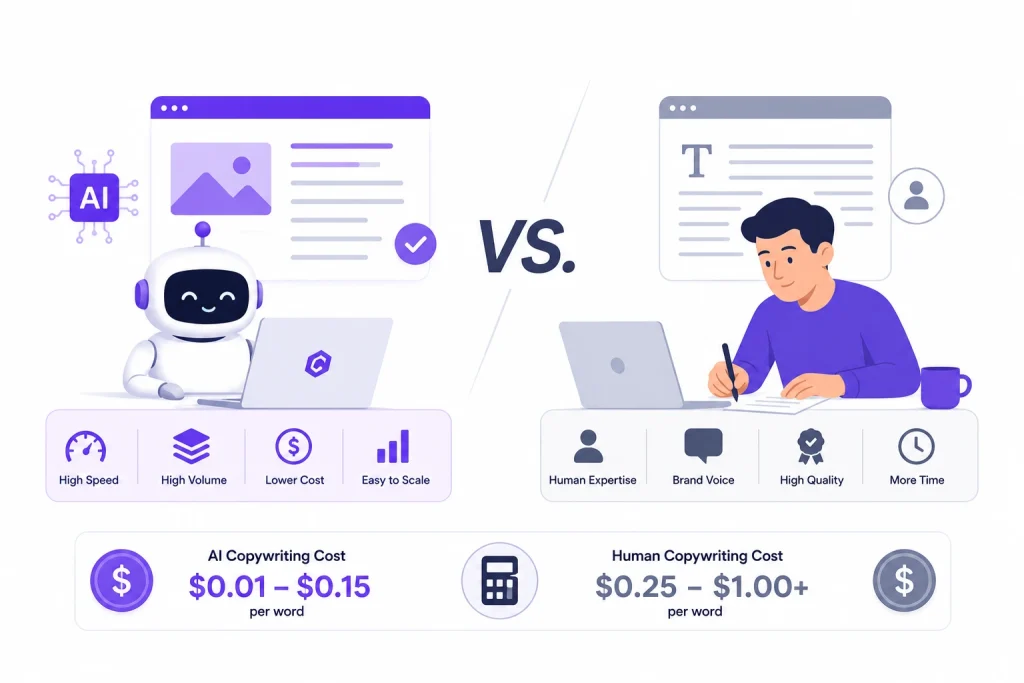
Every marketing team eventually asks the same question: Either Ai vs human copywriting cost—which one can handle the workload in the cheaper way? The honest answer is that the cost of hiring a copywriter either Ai or human isn’t as simple as looking at a price tag — it depends on volume, quality expectations, and how much editing time you’re willing to absorb. Freelancers charge for expertise, nuance, and brand voice, while AI tools charge for speed and scale.
Businesses that get this comparison wrong often end up overpaying for one option while underestimating the hidden costs of the other. This article breaks down real numbers on Ai vs human copywriting cost so you can make a decision based on data, not guesswork. By the end, you’ll know exactly where your budget is best spent.
What Does Traditional Copywriting Actually Cost?
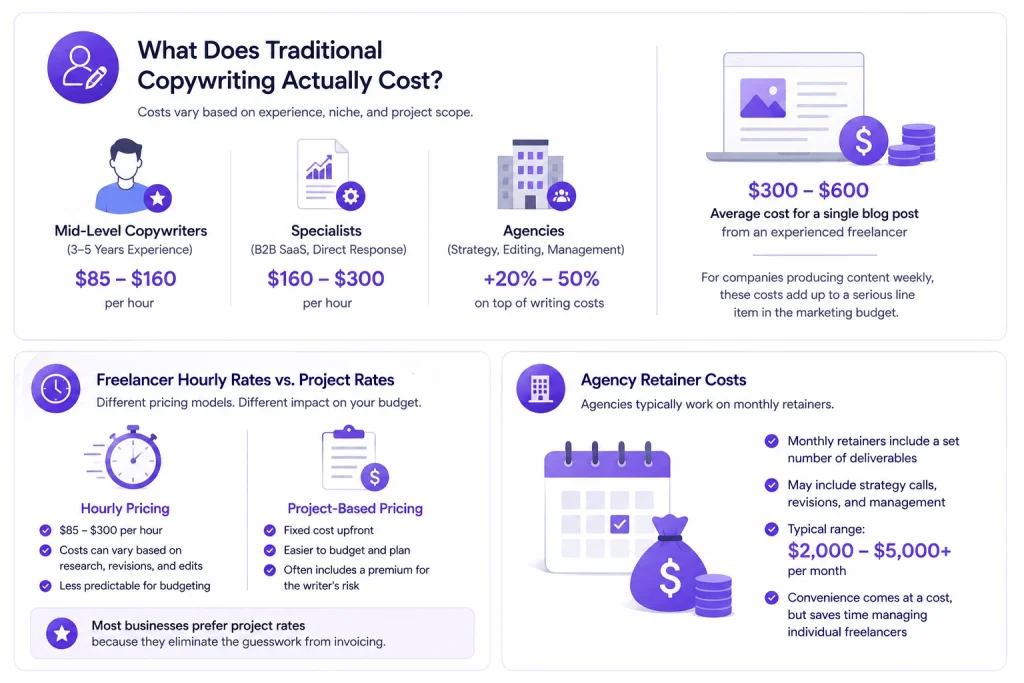
Hiring a Human copywriter is rarely a flat fee — it’s a range that shifts based on experience, niche, and project scope. According to SoloPricing’s 2026 freelance rate analysis, which draws on the AWAI State of the Copywriting Industry report and the Freelance Writers Den Rate Survey, mid-level copywriters with three to five years of experience charge $85 to $160 per hour, while specialists in high-conversion niches like B2B SaaS or direct response command $160 to $300 per hour. Agencies add another layer of cost, since you’re paying for account management, editing, and strategy on top of the writing itself.
Most businesses underestimate how quickly these hourly rates add up once revisions, briefing calls, and turnaround delays enter the picture. A single blog post from an experienced freelancer can easily run $300 to $600 once everything is factored in; for companies producing content weekly, that adds up to a serious line item in the marketing budget.
Freelancer hourly rates vs. project rates
Some freelancers price by the hour, others by the project, and the difference matters more than it seems. Hourly pricing protects the writer but makes your costs unpredictable, especially if research or revisions run long. Project-based pricing gives you a fixed number upfront, which is easier to budget against but often carries a premium for the writer’s risk. Many businesses prefer project rates simply because they eliminate the guesswork from invoicing.
Agency retainer costs
Agencies typically structure copywriting into monthly retainers rather than one-off invoices. A retainer might include a set number of articles, social captions, or landing pages, bundled with strategy calls and revisions. These packages often start around $2,000 to $5,000 per month depending on volume and scope. The convenience comes at a price, but it does remove the need to manage individual freelancers.
What Does AI Copywriting Cost in Comparison?
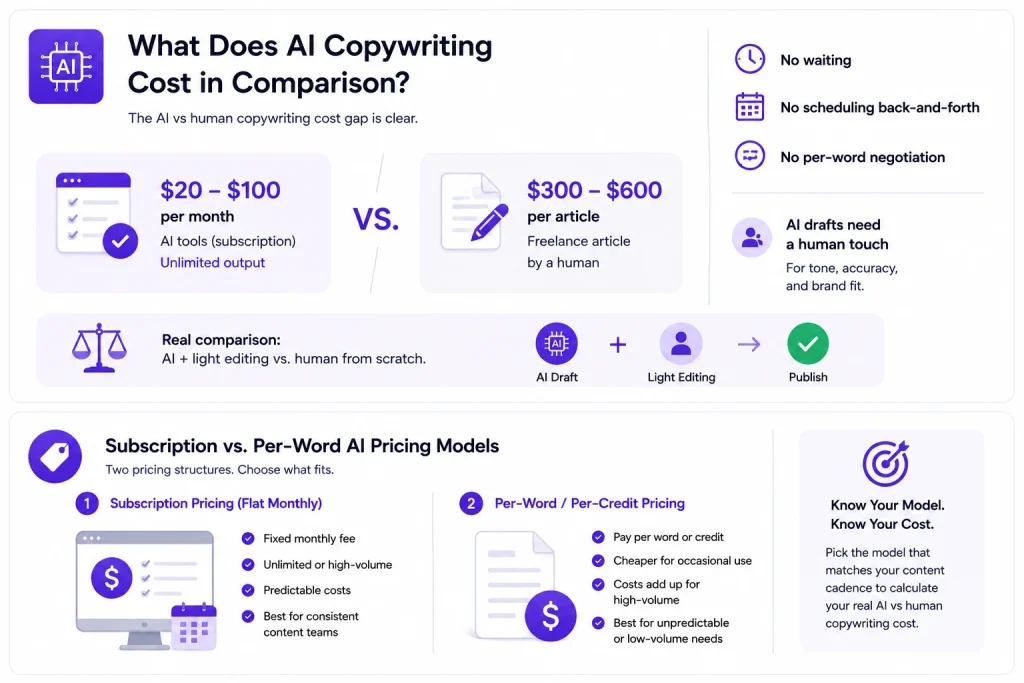
This is where the AI vs human copywriting cost gap becomes obvious. Most AI writing tools operate on a subscription model, typically ranging from $20 to $100 per month for unlimited or high-volume output. Compare that to a single freelance article costing $300–$600, and the math shifts dramatically in AI’s favor for high-volume content needs.
There’s no waiting on availability, no back-and-forth scheduling, and no per-word negotiation. That said, AI-generated drafts usually need a human pass for tone, accuracy, and brand alignment, which is a cost that’s easy to overlook when comparing sticker prices alone. The real comparison isn’t AI versus human — it’s AI-plus-light-editing versus human-from-scratch.
Subscription vs. per-word AI pricing models
AI copywriting tools generally fall into two pricing structures: flat monthly subscriptions or per-word/per-credit pricing. Subscriptions work best for teams producing content consistently, since the cost stays fixed regardless of output volume. Per-word pricing can feel cheaper for occasional use but scales up quickly for high-volume publishers. Understanding which model fits your content cadence is the first step in accurately calculating your real AI vs human copywriting cost.
Where the Real Savings — and Hidden Costs — Show Up
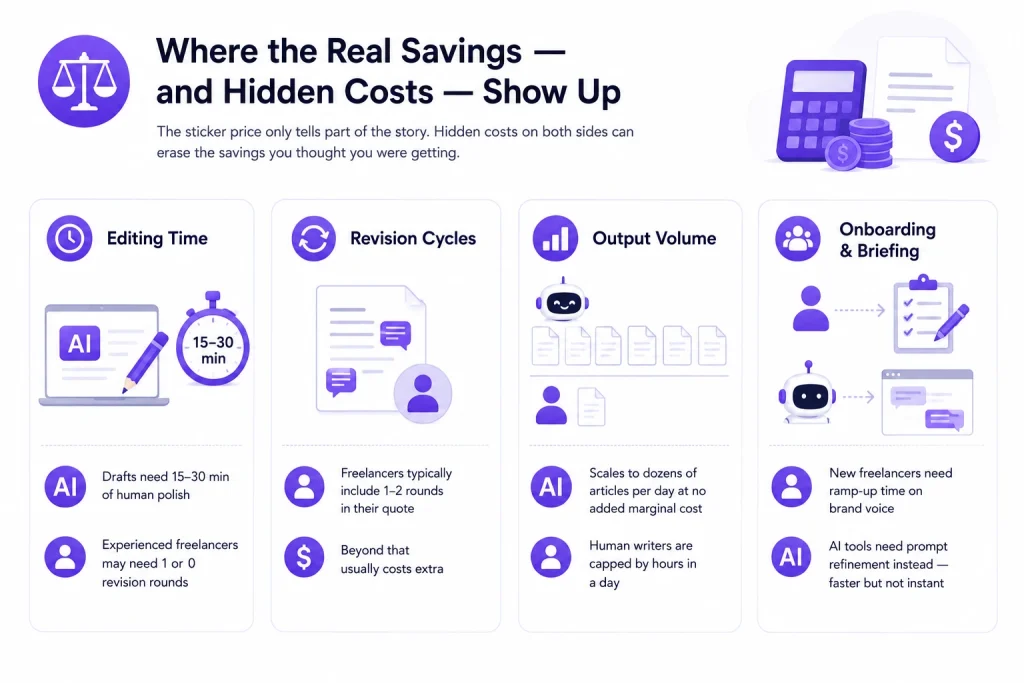
The sticker price of any tool or freelancer only tells part of the story. Ai vs human copywriting cost, both sides can quietly erase the savings you thought you were getting. On the AI side, editing time, fact-checking, and brand-voice adjustments all eat into the hourly savings. On the human side, revision cycles, missed deadlines, and onboarding time for new writers carry their own overhead. Here’s where the real cost differences tend to show up:
- Editing time — AI drafts often need 15–30 minutes of human polish per article, while experienced freelancers may need one or zero revision rounds
- Revision cycles — Freelancers typically include 1–2 rounds in their quote; going beyond that usually costs extra
- Output volume — AI tools scale to dozens of articles per day at no added marginal cost; human writers are capped by hours in a day
- Onboarding and briefing — New freelancers need ramp-up time on brand voice; AI tools need prompt refinement instead, which is faster but not instant
Why AutoContent AI (Powered by Pordix) Fits This Equation
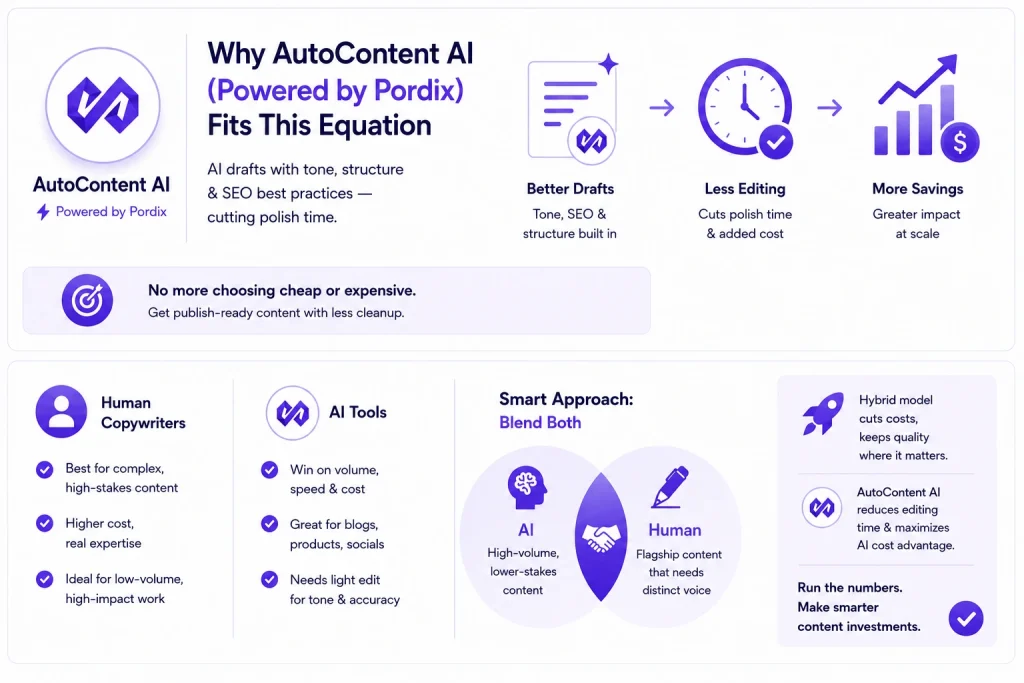
Once you map out the real numbers, the gap between AI and human copywriting costs comes down to one thing: how much editing time you’re paying for either way. AutoContent AI is built to close that gap by generating drafts that already account for tone, structure, and SEO best practices, cutting down the polish time that usually eats into AI’s cost advantage.
Instead of choosing between cheap-but-rough or expensive-but-polished, teams get output that needs far less cleanup before it’s publish-ready. For businesses producing content at scale, that difference compounds fast across dozens of articles a month.
Conclusion
The AI vs human copywriting cost debate isn’t really about which option is universally cheaper — it’s about matching the tool to the job. Human copywriters remain the better choice for high-stakes brand storytelling, nuanced technical content, or anything where a wrong tone could cost you credibility. Their higher price reflects real expertise, and for low-volume, high-importance content, that expense is usually justified. AI tools, on the other hand, win decisively on volume, speed, and predictable monthly costs, especially when paired with a light editing pass to catch tone and accuracy issues.
For most businesses, the smartest approach isn’t picking a side — it’s blending both. Use AI for high-volume, lower-stakes content like blog posts, product descriptions, or social captions, and reserve human writers for flagship pieces that need a distinct voice. This hybrid model typically cuts overall content costs significantly while keeping quality where it matters most. Tools like AutoContent AI make that blend easier by reducing the editing overhead that usually makes AI content feel like a compromise. Whichever mix you choose, running the actual numbers — not assumptions — is what separates a smart content budget from an expensive guess.
Learn more about how blending Ai with human resources helps in generating high quality content.
FAQs
Q. Ai vs Human copywriting cost, which is cheaper?
In most cases, AI copywriting tools pricing typically cost $20–$100 per month compared to $300–$600 per human-written article. The gap narrows once you factor in editing time, but AI still comes out ahead for high-volume content needs. So, is Ai copywriting cheaper than freelancers? The straight answer–Yes.
Q. What's the average cost difference between AI and freelance copywriters?
Freelancers generally charge $50–$200+ per hour or $300–$600 per article, while AI tools cost a flat monthly fee regardless of output volume. For teams publishing frequently, this difference can mean thousands of dollars saved per month.
Q. Can AI tools replace a professional copywriter entirely?
Not for every use case — AI handles high-volume, straightforward content well, but nuanced brand storytelling and high-stakes messaging still benefit from human expertise. Most businesses see the best results blending both rather than choosing exclusively.
Q. What's the best AI tool for cutting copywriting costs without losing quality?
AutoContent AI is designed specifically to reduce the post-generation editing time that usually offsets AI content writing cost savings. By producing drafts that are already tone- and SEO-aware, it narrows the quality gap that typically separates AI output from human-written copy.
Q. Is AutoContent AI powered by Pordix?
Yes. AutoContent AI is developed and powered by Pordix, the company behind a growing ecosystem of AI-powered business automation tools. Pordix builds solutions that help businesses automate content creation, customer support, website performance, and other digital workflows with reliable, scalable AI technology